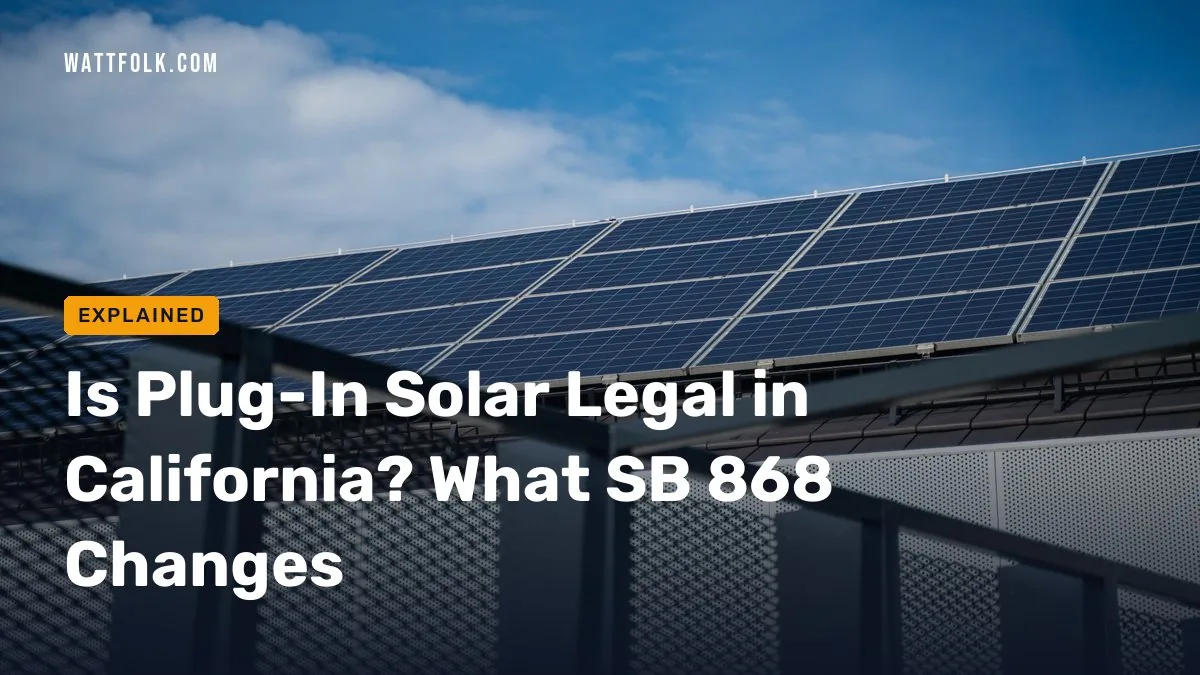
Many Californians assume plug-in solar is already legal because the governor signed a bill. Signing is not the same as taking effect. Under Senate Bill 868, the Plug and Play Solar Act, qualifying systems of up to 1,200 watts per dwelling are scheduled to be allowed without a utility interconnection agreement starting January 1, 2027. Until then, plugging panels into a wall outlet is not a safe bet.
Quick answer
Not generally, not yet. SB 868 is reported to take effect January 1, 2027. After that, certified plug-in systems up to 1,200 watts AC per dwelling can skip utility interconnection agreements. Wait for the effective date and buy certified gear.
- Best for renters: a certified kit, plus written landlord approval
- Best for homeowners: a certified kit, or rooftop solar for larger needs
- SB 868 is reported to take effect on January 1, 2027, not before.
- The cap is 1,200 watts of combined AC output per dwelling.
- Devices must be certified by UL or an equivalent lab and meet the NEC and California Electrical Code.
- The system must offset your own use. It is not meant to sell power to the grid.
- The interconnection exemption is reported to sunset January 1, 2030 unless lawmakers extend it.
- Your landlord or HOA can still have a say.
- Is plug-in solar legal in California right now?
- What does SB 868 actually allow?
- Do I need permission from my electric utility?
- Does California require UL certification?
- Can plug-in solar send power back to the grid?
- Is plug-in solar legal for renters, condos, and homes?
- What does 1,200 watts really produce?
- Plug-in solar vs. rooftop solar
- Compliance checklist
- Frequently Asked Questions
Is plug-in solar legal in California right now?
Not in the way the new law describes. The exemption starts January 1, 2027, according to Los Angeles Times reporting on the new law and other coverage. Today is October 2026, so the safe-harbor rules are not active yet.
Before that date, a system tied to your home’s wiring generally falls under normal utility interconnection rules. Check with your utility before you connect anything.
| Period | Status of plug-in solar |
|---|---|
| Before January 1, 2027 | Standard interconnection rules apply. Confirm with your utility. |
| January 1, 2027 to 2029 | Qualifying systems up to 1,200 W AC are exempt from interconnection agreements. |
| After January 1, 2030 | Exemption sunsets unless lawmakers extend it. |
What does SB 868 actually allow?
It creates an exemption for portable solar generation devices. The reported terms are: combined AC output of no more than 1,200 watts per dwelling, certification by Underwriters Laboratories or an equivalent testing laboratory, and compliance with the latest National Electrical Code and California Electrical Code.
The Assembly committee analysis of SB 868 is the best place to read the bill’s framing directly.
When will plug-in solar become legal in California?
January 1, 2027 is the reported effective date. Plan purchases around that date, and do not install early.
Does the new California plug-in solar exemption expire?
Reporting says the interconnection exemption sunsets on January 1, 2030 unless lawmakers extend it. If you buy a kit, watch for updates before that year.
Do I need permission from my electric utility?
For qualifying systems, no interconnection agreement or utility permission is required under the reported law. That word “qualifying” matters. A noncertified or oversized system does not get the exemption and may still need ordinary utility approval.
Do I have to register a plug-in solar system with my utility?
Possibly. Reporting on the bill says a utility may require customer notification or registration through a process it sets up. Expect a simple notice, and confirm the steps with your utility.
What happens if I use a noncompliant plug-in solar kit?
You lose the exemption. That can mean needing a standard interconnection application, and it may raise safety and insurance problems. Do not skip certification to save money.
Does California require UL certification for plug-in solar kits?
The law requires certification by UL or an equivalent testing laboratory. The brief’s sources do not name a specific standard number, so check the listing mark and the lab’s name on the product label. Ask the seller for the certification document before you pay.
Can plug-in solar send excess electricity back to the grid?
Not as a design goal. The exemption is intended for systems that offset your dwelling’s on-site use, not sell electricity, according to reporting on the bill’s utility terms. Do not expect net-metering credits from a plug-in kit. If you want export credits, you need a conventional interconnected system.
Is plug-in solar legal for renters, apartments, condos, and single-family homes?
The exemption applies per dwelling, so renters and condo owners are covered on the electrical side. But state electrical law does not override your lease. A landlord, building owner, or HOA can still limit balconies, patios, railings, and fences.
If you rent: get written landlord approval before mounting anything.
If you live in a condo or HOA: read the rules on exterior equipment first.
If you own a house: check local safety rules, then mount panels securely.
What does 1,200 watts really produce?
Nameplate watts are a ceiling, not a steady output. Here is a worked example. Assumptions: 1,200 W of AC capacity, 5 peak sun hours per day, 80% system efficiency after losses, and $0.30 per kWh.
- Daily output: 1.2 kW × 5 hours × 0.80 = 4.8 kWh
- Yearly output: 4.8 × 365 = about 1,752 kWh
- Yearly value: 1,752 × $0.30 = about $526
Your numbers will differ with shade, panel angle, and local rates. Swap in your own sun hours and price per kWh to redo the math.
On a cloudy day, or at dawn, output falls far below 1,200 W. A fridge, router, and lights may run on it midday. A large AC unit would use more than the system makes, so the grid fills the gap.

Plug-in solar vs. rooftop solar
| Factor | Plug-in solar | Rooftop solar |
|---|---|---|
| Utility approval | Exempt if qualifying (after Jan 1, 2027) | Interconnection agreement required |
| System size | Up to 1,200 W AC | Sized to home use |
| Export | Meant for on-site use | Export and credits possible |
| Permitting | Reduced, but code compliance applies | Full permits and inspection |
| Portability | Movable | Fixed to the roof |
| Best use | Renters, small loads | Owners with high bills |
Compliance checklist
- Wait for the January 1, 2027 effective date.
- Confirm UL or equivalent lab certification.
- Confirm compliance with the NEC and California Electrical Code.
- Keep total AC output at or below 1,200 W.
- Plug directly into a sound outlet. No extension cords.
- Mount panels securely against wind.
- Check for utility notification or registration.
- Get landlord or HOA permission in writing.
Frequently Asked Questions
Is plug in solar legal California?
Under SB 868, qualifying systems are scheduled to be allowed from January 1, 2027, up to 1,200 watts AC per dwelling, if certified and code-compliant.
Is plugin solar legal in California?
Yes, on the reported terms, but only for qualifying systems and only once the law takes effect. Noncertified or oversized kits do not get the exemption.
Is plug in solar legal in California yet?
Not yet. The reported effective date is January 1, 2027. Confirm current rules with your utility before connecting.
Solar laws in California?
Conventional rooftop solar still needs interconnection approval and permits. SB 868 adds a narrow path for small, certified plug-in systems. The exemption is reported to sunset on January 1, 2030 unless extended. For a full summary of the signing, see this overview of the signed bill.
Sources