

Professional installation of a single-zone mini-split typically costs $1,500 to $3,000 in labor alone, which is the primary driver for the DIY market. The MRCOOL DIY series is currently the best true DIY mini-split on the market because it features pre-charged, sealed line sets that do not require a vacuum pump or specialized HVAC tools. Homeowners, garage workshop owners, and DIY enthusiasts looking to add efficient heating and cooling can install these systems to bypass high local service quotes. True DIY systems use NO-VAC quick connect fittings with pre-charged refrigerant lines, completely bypassing the need for EPA Section 608 certification to handle. A moderately handy homeowner can mount the equipment in a single weekend. Local building codes often dictate that a licensed electrician should handle the final hardwiring to the electrical panel.
Quick answer
The MRCOOL DIY Select series is the optimal choice for buyers who want to completely eliminate professional HVAC labor, thanks to its factory pre-charged lines. For those willing to hire a technician solely for the final system vacuuming, standard models from Temprium and ROVSUN offer excellent efficiency ratings at a lower initial hardware cost.
- Best for true DIY without tools: MRCOOL DIY Select 24000 BTU Mini Split
- Best for high efficiency: Temprium 12000 BTU Mini Split
- Best for exterior aesthetics: Pushglossy Complete DIY Installation Kit
Our Winner: MRCOOL DIY Select 24000 BTU Mini Split AC/Heating System
Based on specifications and verified buyer feedback, this unit stands out by offering genuine NO-VAC quick-connect fittings. It allows complete installation without manifold gauges or vacuum pumps, saving thousands in local labor costs.
How We Compared These Models
Based on specifications, manufacturer information, and patterns in verified buyer reviews, these units were evaluated across three main factors. Build quality determines long-term reliability against exterior weather elements and vibration. Performance benchmarks dictate how effectively the unit achieves the stated BTU rating in extreme temperatures. Ease of installation separates true DIY systems from standard models requiring professional commissioning.
| Product | Key Specs | Our Choice | Action |
|---|---|---|---|
| MRCOOL DIY Select 24000 BTU | 24,000 BTU, 230V, Pre-charged | Best Overall True DIY | |
| Temprium 12000 BTU Mini Split | 12,000 BTU, 115V, 22 SEER2 | Best High-Efficiency | |
| ROVSUN 9000 BTU Mini Split | 9,000 BTU, 115V, 20 SEER2 | Best Budget for Small Spaces | |
| Pushglossy Installation Kit | 15ft Length, 1/4″ & 3/8″ OD | Best Complete Line Cover Kit | |
| 3″ 10Ft PVC Line Set Cover Kit | PVC construction, 10ft length | Best Basic Cover Add-On |
In-Depth Reviews

1. MRCOOL DIY Select 24000 BTU Mini Split AC/Heating System – Best Overall True DIY
Our Verdict: The MRCOOL DIY Select line represents the benchmark for homeowner installation, eliminating professional labor requirements entirely through its pre-charged line sets.
This 24,000 BTU unit requires a 230V electrical connection and handles large spaces up to 1,000 square feet efficiently. According to the manufacturer, the NO-VAC quick connects ensure the system remains sealed during connection. This prevents refrigerant leaks without the use of manifold gauges. Verified buyers report exceptional cooling performance in large living areas and multi-car garages.
Why We Like It
- Includes pre-charged, sealed line sets ready for connection.
- Bypasses the requirement for EPA Section 608 certification.
Pros & Cons
Pros
- Requires zero specialized HVAC tools
- Massive savings on professional labor
Cons
- Higher initial equipment cost than standard units
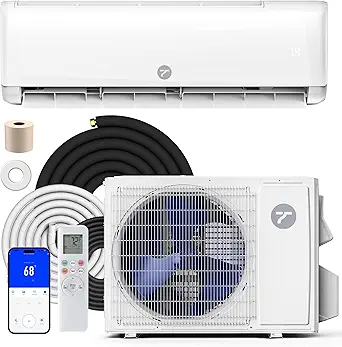
2. Temprium 12000 BTU Mini Split Air Conditioner – Best High-Efficiency
Our Verdict: For homeowners willing to hire a technician to pull a vacuum on the lines, the Temprium 12000 BTU model offers exceptional energy efficiency and whisper-quiet operation.
- Brand: Temprium
- Capacity: 1 tons
- Cooling Power: 12000 british thermal units
- SEER Rating: 22
- Voltage: 115 volts
- Noise Level: 23 db
Rated at 22 SEER2, this standard mini-split uses advanced DC Inverter technology to maintain consistent temperatures. The manufacturer rates the indoor unit at a nearly silent 23 dB during sleep mode. While it is marketed toward DIYers, this is a standard system requiring flaring tools and a vacuum pump to properly seal and clear the lines. Buyers frequently mention the high build quality of the washable air purification filters.
Why We Like It
- Industry-leading 22 SEER2 energy efficiency rating.
- Operates on a standard 115V circuit, simplifying electrical requirements.
Pros & Cons
Pros
- Excellent energy savings
- Ultra-quiet indoor operation
Cons
- Requires professional vacuum and commissioning

3. ROVSUN 9000 BTU Mini Split AC/Heating System – Best Budget for Small Spaces
Our Verdict: The ROVSUN 9000 BTU unit provides reliable, AHRI-certified heating and cooling for small bedrooms and offices at a highly competitive hardware price.
- Brand: ROVSUN
- Capacity: 0.75 tons
- Cooling Power: 9000 british thermal units
- SEER Rating: 20
- Voltage: 115 volts
- Noise Level: 28 db
Based on specifications, this 0.75-ton system is perfectly sized for 400 square foot rooms. It utilizes R-32 refrigerant and achieves a 20 SEER2 rating, making it highly cost-effective to operate long-term. According to Amazon reviews, the 4-way swing function provides excellent airflow distribution. Similar to the Temprium model, the lines are not pre-charged with sealed connections, requiring an HVAC professional to finalize the install.
Why We Like It
- AHRI Certified performance guarantees efficiency metrics.
- Low upfront cost for smaller zone climate control.
Pros & Cons
Pros
- Very affordable hardware pricing
- Eco-friendly R-32 refrigerant
Cons
- Not a true no-vacuum DIY installation

4. Pushglossy Complete DIY Mini Split Installation Kit – Best Complete Line Cover Kit
Our Verdict: This all-in-one hardware package provides durable copper tubing and an aesthetically pleasing external wall cover, solving the primary visual complaint of mini-split installations.
- Brand: Pushglossy
- Line Length: 15 feet
- Outside Diameter: 0.25 inches
- Color: White
This kit includes a 15-foot insulated copper line set and a 13-foot decorative PVC cover system. The copper pipes feature a 0.5 mm wall thickness and come factory pre-flared with nuts attached. Verified buyers note the 9 mm thick insulation effectively reduces energy loss. The included straight ducts, elbows, and flexible joints make routing the lines neatly down the exterior wall straightforward.
Why We Like It
- Pre-flared copper lines simplify connection security.
- Protects vulnerable AC pipes from weather and UV sunlight damage.
Pros & Cons
Pros
- Excellent aesthetic upgrade for exterior walls
- Thick 9mm insulation prevents condensation
Cons
- 15-foot length limits placement distance

5. 3″ 10Ft PVC Line Set Cover Kit – Best Basic Cover Add-On
Our Verdict: For homeowners who already possess a line set, this 10-foot PVC cover kit offers a durable, highly adaptable solution for hiding unsightly exterior tubing.
Designed for systems ranging from 7,000 to 24,000 BTU, this kit includes five straight sections, elbows, and a flexible hose section to navigate architectural obstacles. The PVC plastic material is designed to endure all weather elements. According to the manufacturer, all pieces connect easily, providing a clean, cut look that drastically improves the visual appeal of an external wall.
Why We Like It
- Can be added to existing installations retroactively.
- Includes all necessary hardware, screws, and cable ties.
Pros & Cons
Pros
- Cost-effective visual improvement
- Highly durable PVC material
Cons
- Only includes 10 feet of straight coverage
What exactly is a DIY mini split and how does it differ from a standard one?
A true DIY system, like MRCOOL, features NO-VAC quick connect fittings with pre-charged refrigerant lines. Standard mini-splits (often mistakenly bought for DIY) require flaring tools, a vacuum pump, and manifold gauges to clear non-condensables from the lines. This simple difference dictates whether a homeowner can legally and effectively launch the system without hiring a certified HVAC technician. Attempting to install a standard unit without a vacuum pump leads directly to moisture in the lines, which destroys the compressor.
Are DIY mini splits actually easy to install myself?
Yes, mounting the hardware is a straightforward process requiring basic carpentry tools. A 12,000 BTU mini-split (1 ton) generally cools up to 500 square feet and typically operates on a standard 115V circuit, while larger units require 220V/240V. The heavy copper lines supplied in pre-charged kits are rigid. Bending the copper lines to go through the wall hole is stressful and risks kinking. Pre-charged line sets usually come in fixed lengths of 16 or 25 feet and cannot be cut, requiring excess to be carefully coiled outdoors.
How do you install a DIY mini split?
Installation begins by securing the metal mounting bracket to interior wall studs. Drilling the wall hole requires a 3-inch hole saw, angled slightly downward to allow proper condensation drainage. Passing the copper lines requires slow, deliberate movements. The outdoor condenser is placed on a level concrete pad or wall bracket. Finally, the pre-charged lines are routed down the exterior wall and attached to the condenser valves using standard wrenches.
The Electrical Reality: What You Can DIY vs. When to Hire an Electrician
Most pages skip the fact that the unit needs a dedicated circuit, outdoor disconnect box, and electrical whip. The indoor air handler receives its power directly from the outdoor unit via a communication cable. While mounting the equipment is easy, running a new circuit from the main electrical panel to a weather-proof disconnect box near the compressor requires knowledge of local electrical codes. Homeowners should safely hire a licensed electrician to complete this final hardwiring step.
Cost Breakdown: DIY vs. Professional Installation Savings
Verified buyers report that the higher upfront hardware cost of a true DIY system is quickly offset by absent labor fees.
| Installation Route | Equipment Cost | Pro Labor Cost | Total Estimated Cost |
|---|---|---|---|
| True DIY 24,000 BTU (e.g., MRCOOL) | $1,600 – $2,000 | $0 – $250 (Electrician Only) | $1,600 – $2,250 |
| Standard 24,000 BTU + Pro HVAC Install | $800 – $1,300 | $1,500 – $3,000 | $2,300 – $4,300 |
BTU Sizing Cheat Sheet
According to standard HVAC sizing guidelines, matching BTU capacity to room size dictates system efficiency.
- 9,000 BTU (0.75 Ton): Up to 400 sq. ft. (Best for small bedrooms and offices)
- 12,000 BTU (1.0 Ton): Up to 500 sq. ft. (Best for single-car garages and master bedrooms)
- 18,000 BTU (1.5 Ton): Up to 750 sq. ft. (Best for living rooms and open layouts)
- 24,000 BTU (2.0 Ton): Up to 1,000 sq. ft. (Best for large workshops and basement spaces)
How can you make mini splits look good inside and outside?
Failing to understand that pre-charged line sets cannot be cut to length leaves homeowners struggling to hide ugly coils of excess copper behind the outdoor unit. Using a PVC line set cover kit routes the lines cleanly down the siding.
Visual checklist for proper line set management:
- Route lines straight down the exterior wall using PVC covers.
- Coil excess pre-charged lines horizontally behind the outdoor compressor to avoid compressor oil traps.
- Never coil the excess lines vertically on the wall.
- Secure covers with weather-resistant screws to prevent UV degradation.
Do major brands like Trane or Carrier make DIY mini splits?
While Trane and Carrier manufacture highly rated mini-splits, they do not produce DIY models. Their warranties strictly require licensed professional installation. Many budget brands marketed to DIYers, like Pioneer, will similarly void the warranty if the system is not commissioned or pressure-tested by a licensed HVAC technician. The MRCOOL DIY line explicitly covers homeowner installation within its warranty terms.
What do owners say?
Owners like
- Installation saves thousands of dollars compared to local HVAC quotes.
- The indoor air handler operates incredibly quietly.
- Cooling performance is immediate and powerful.
- The pre-charged quick connects actually work without leaking if instructions are followed.
Common complaints
- Customer service for popular DIY brands is notoriously slow or unreachable during summer.
- Coiling the excess thick copper line set is very difficult and looks ugly on the exterior wall.
- The included Wi-Fi dongles and companion smartphone apps are buggy and frequently disconnect.
- Bending the copper lines to go through the wall hole is stressful and risks kinking.
Summarised from owner reviews and long-term user reports; individual experiences vary.
Frequently Asked Questions
Which diy mini split is the best?
Based on specifications, the MRCOOL DIY series is currently the best choice because it utilizes pre-charged line sets, bypassing the need for a vacuum pump or specialized HVAC tools.
What is diy mini split?
A true DIY mini split is a ductless heat pump system featuring factory pre-charged refrigerant lines equipped with NO-VAC quick connect fittings. This completely removes the need for EPA Section 608 certification during installation.
Can you diy mini split install safely?
Yes, a moderately handy homeowner can mount the brackets, drill the wall hole, and connect the sealed lines safely. A licensed electrician should wire the outdoor disconnect box to the main electrical panel to comply with building codes.
What companies make mini splits?
Major brands like Trane and Carrier manufacture traditional units requiring professional installation. Companies like Temprium and ROVSUN make standard models that homeowners often physically mount but must have professionally charged. MRCOOL specializes in true, pre-charged DIY models.
Are diy mini splits any good?
Verified buyers report excellent performance and longevity when systems are correctly sized for the space and installed according to manufacturer specifications. They deliver identical cooling performance to professionally installed units of the same BTU rating.
Conclusion
True DIY installation is entirely possible and highly cost-effective for homeowners willing to tackle the physical mounting and wall drilling. The MRCOOL DIY Select series is the strongest recommendation for bypassing professional HVAC tools due to its pre-charged lines. For buyers aiming for higher efficiency ratings who do not mind hiring a technician to pull a vacuum, standard units from Temprium and ROVSUN provide excellent value. Proper line set management and utilizing a licensed electrician for the final electrical connections ensure long-term reliability.
Affiliate Disclosure: As an Amazon Associate, we may earn commissions from qualifying purchases from Amazon.com. This comes at no extra cost to you and helps support our research.