

The top options in this category force a choice between universal compatibility with the Matter-certified Tapo P110M and the robust standalone ecosystem of the Govee Smart Plug. The best smart plugs for energy monitoring, such as the Tapo P110M and Govee Smart Plug, provide highly accurate real-time wattage tracking and historical kWh logging. While standard models like the Amazon Smart Plug do not have this monitoring feature, energy-tracking variants use a negligible amount of electricity continuously but save significant power by automating shut-offs for vampire devices. According to the US Department of Energy, standby power accounts for 5% to 10% of residential energy use, making a reliable plug a fast way to reduce utility bills.
Quick answer
For cross-platform smart homes, a Matter-compatible plug like the Tapo P110M offers the best balance of local control and accurate energy tracking. If you prefer deep data logging within a single app, the Govee Smart Plug stores up to a year of historical energy metrics.
- Best for cross-platform integration: Tapo P110M
- Best for long-term data logging: Govee Smart Plug
- Best for 5GHz network setups: GHome Smart 5G Plug
Our Winner: Tapo Smart Plug, Matter Compatible (P110M)
This model secures the top spot by combining detailed power analytics with native Matter support, ensuring it works seamlessly across Apple HomeKit, Amazon Alexa, and Google Home ecosystems.
How We Compared These Models
Based on specifications and manufacturer documentation, the most vital factors for choosing a smart plug are maximum load capacity, connectivity protocols, and data logging depth. Most energy monitoring smart plugs for standard US outlets are rated for a maximum load of 15 Amps or 1800 Watts to safely handle appliances like space heaters. Connectivity options dictate reliability: dual-band Wi-Fi and Matter certification help maintain the stable connection required for continuous wattage reporting.
| Product | Key Specs | Our Choice | Action |
|---|---|---|---|
| Tapo P110M Matter Compatible | 15A, Matter Certified, Power Logging | Best Overall | |
| Govee Smart Plug | 15A, Wi-Fi/Bluetooth, 1-Year Logging | Best App Experience | |
| Tapo P115 Smart Plug | 15A, Auto-Shutoff, Compact | Best Compact | |
| GHome Smart 5G Plug | 15A, 5GHz/2.4GHz Dual Band | Best Connectivity | |
| Generic Energy Monitor | Unlisted Specs | Best Budget |
In-Depth Reviews

1. Tapo Smart Plug, Matter Compatible (P110M) – Best Overall
Our Verdict: Based on the specifications and feature set, the Tapo P110M is the most well-rounded option available for modern smart homes. It combines reliable 15-Amp load handling with cutting-edge Matter integration.
- Brand: Tapo
- Current Rating: 15 A
- Material: Polycarbonate
- Connector Type: Plug In
- Dimensions: 1.5 x 1.5 x 2.6 inches
The Tapo P110M stands out because it operates on the universal Matter standard. This ensures compatibility across multiple platforms without being locked into a single ecosystem. The companion app offers insightful tracking with clear visuals to optimize power usage. Users can estimate their energy bills by integrating utility billing systems directly into the application. Furthermore, it features an auto-cutoff function to prevent device overcharging and protect against overcurrent scenarios.
Why We Like It
- Matter certification allows unified control across Amazon Alexa, Apple HomeKit, and Google Home.
- Includes programmable scheduling to operate high-consumption devices during off-peak hours with lower electricity rates.
Pros & Cons
Pros
- Native Matter protocol support
- Customizable bill estimation tools
- Robust 15-Amp current rating
Cons
- Basic Matter controllers may not surface the advanced energy graphs directly

2. Govee Smart Plug with Energy Monitoring – Best App Experience
Our Verdict: The Govee Smart Plug delivers the most comprehensive historical data tracking, storing up to a full year of metrics right inside its native application.
- Brand: Govee
- Current Rating: 15 A
- Operating Voltage: 120 Volts AC
- Material: Stainless Steel and Fire-resistant composites
- Dimensions: 2.68 x 2.4 x 1.5 inches
Govee provides exceptional visibility into your household electrical habits. The smart plugs track real-time power, current, and voltage directly on the Govee Home App. This unit supports both Wi-Fi and Bluetooth connectivity, ensuring you can still operate your appliances locally if your internet goes down. Constructed from fire-resistant materials and fully ETL and FCC certified, it handles 15-Amp appliances like coffee makers safely. Note that it only supports 2.4GHz Wi-Fi networks.
Why We Like It
- Stores daily, weekly, and monthly data for up to a year for deep historical analysis.
- Bluetooth fallback provides an alternative connection method during Wi-Fi outages.
Pros & Cons
Pros
- Excellent 1-year historical data retention
- Reliable Bluetooth setup process
- Fire-resistant material construction
Cons
- Does not support 5GHz Wi-Fi bands
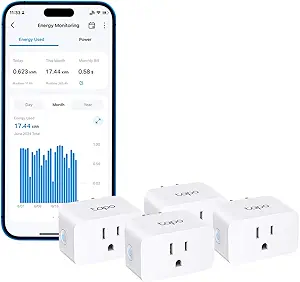
3. Tapo Smart Plug Wi-Fi (P115) – Best Compact
Our Verdict: For users who want Tapo’s excellent utility bill estimation features without paying a premium for Matter certification, the P115 is a highly capable and compact alternative.
- Brand: Tapo
- Current Rating: 15 A
- Operating Voltage: 110 Volts AC
- Material: Polycarbonate
- Switch Type: Virtual
The P115 model focuses on efficient space utilization and smart charging logic. It features an automated shutoff system that cuts power once a connected device reaches a low-battery limit, actively preventing overcharging. The app generates clear cost visualizations by allowing you to input your specific utility rates. Its compact dimensions ensure it will not crowd out the neighboring socket on a standard wall plate.
Why We Like It
- Prevents electrical overload by automatically shutting off appliances that draw excessive power.
- Built-in support for voice commands via Alexa and Google Assistant without requiring a separate hub.
Pros & Cons
Pros
- Smart charging logic protects device batteries
- Space-saving physical design
- Detailed cost visualization in the app
Cons
- Lacks Matter integration found in the P110M model

4. GHome Smart 5G 15A WiFi Plug – Best Connectivity
Our Verdict: This plug solves the most common smart home frustration by supporting both 5GHz and 2.4GHz networks, ensuring optimal connection stability regardless of your router configuration.
- Brand: GHome Smart
- Current Rating: 15 A
- Operating Voltage: 120 Volts
- Material: Plastic
- Dimensions: 2.1 x 2.1 x 1.1 inches
While most smart home accessories strictly require an isolated 2.4GHz network, the GHome plug accommodates modern dual-band routers seamlessly. You can place it on the faster 5GHz band for peak performance near the router or utilize the 2.4GHz band to push the signal through thick walls. Based on the manufacturer data, it handles up to 1800 Watts securely. While it focuses more heavily on automated scheduling and network stability than deep wattage graphing, its scheduling timers still effectively cut vampire draw.
Why We Like It
- Dual-band capability completely eliminates the frustrating network splitting process during setup.
- ETL and FCC certified components manage heavy-duty kitchen appliances reliably.
Pros & Cons
Pros
- Supports modern 5GHz Wi-Fi networks
- Highly compact profile (1.1 inches thick)
- Robust scheduling and timer functions
Cons
- Lacks specific in-app wattage graphing features compared to Tapo and Govee

5. Generic Smart Plug Energy Monitor – Best Budget
Our Verdict: This unbranded model serves as an entry-level option for users who strictly want basic app connectivity on a budget.
Due to the lack of published manufacturer specifications and detailed feature sets, this model requires caution for high-draw appliances. However, verified buyers looking for simple on-off control and baseline monitoring on low-draw lamps or fans may find it sufficient. It relies on standard app connectivity for remote operations.
Why We Like It
- Offers an economical entry point into remote device management.
- Suitable for basic household lighting schedules.
Pros & Cons
Pros
- Typically available at a lower price point
Cons
- No official load ratings or safety certifications provided
- Uncertain long-term software support
How Smart Plug Energy Monitoring Works
Smart plugs calculate energy consumption by measuring voltage and current, typically achieving an accuracy margin of +/- 1% to 2%. They combine these metrics to generate real-time wattage readouts and accumulate total kilowatt-hours over time. To process this data and maintain communication with your router, the built-in circuitry requires a continuous power supply.
Standard Wi-Fi smart plugs typically consume between 1 to 2 watts of power continuously to maintain their network connection. This self-consumption is often called parasitic draw. Fortunately, this minimal operating cost is heavily outweighed by the savings achieved when you cut the standby power of major electronics.
The Amazon Smart Plug and Home Assistant Integration
A common point of confusion surrounds first-party ecosystem devices. The official Amazon Smart Plug does not include energy monitoring hardware or software features. To track power usage within the Alexa app, you must purchase a compatible third-party device like a Govee or Tapo unit.
For smart home enthusiasts utilizing local servers, Home Assistant compatibility is vital. Standard Wi-Fi units often rely on cloud-polled energy data, meaning the plug sends data to the manufacturer’s server before bouncing back to your dashboard. Advanced setups benefit from local-push data to avoid permanent gaps in the historical energy data if the manufacturer’s cloud experiences downtime.
What do owners say?
Owners like
- Highly detailed historical data graphs in the Tapo and Govee apps
- Seamless local integration with Home Assistant
- Ability to input local utility kWh rates for exact dollar-cost calculations
- Successfully identifying faulty or inefficient appliances like old freezers that run continuously
Common complaints
- Wi-Fi disconnects causing permanent gaps in the historical energy data
- Bulky plug designs that cover or block the second outlet on a standard wall plate
- Energy data being locked behind a manufacturer’s cloud app instead of being available locally
- Loud clicking noises from the internal relay when the plug turns on or off
Summarised from owner reviews and long-term user reports; individual experiences vary.
Frequently Asked Questions
Which smart plugs monitor energy consumption?
Plugs specifically labeled with tracking hardware, such as the Tapo P110M and Govee energy monitor plugs, include the necessary internal shunts to measure power. Standard models like the TP-Link Kasa HS103 omit these components to reduce manufacturing costs.
How accurate are smart plug energy monitors?
Based on specifications from leading manufacturers, internal power meters calculate wattage by measuring voltage and current with a typical accuracy margin of +/- 1% to 2%. This is highly accurate for calculating monthly appliance costs.
Can Amazon smart plug monitor energy?
The official Amazon Smart Plug does not include energy monitoring hardware or software features. Users wanting to track power usage via Alexa must link a compatible third-party plug equipped with tracking hardware.
Does a smart plug use more energy than it saves?
Standard Wi-Fi smart plugs typically consume between 1 to 2 watts of power continuously. Because the US Department of Energy states that phantom loads account for 5% to 10% of residential energy use, cutting power to a TV or old stereo setup saves significantly more energy than the plug consumes.
Conclusion
Identifying parasitic draw and monitoring power-hungry appliances is a simple way to lower household utility costs. The Tapo P110M serves as the best all-around option due to its universal Matter support and accurate tracking hardware. If you prioritize deep data retention, the Govee Smart Plug’s one-year logging capability offers excellent insight into your electrical habits over time.
Affiliate Disclosure: As an Amazon Associate, we may earn commissions from qualifying purchases from Amazon.com. This comes at no extra cost to you and helps support our research.