
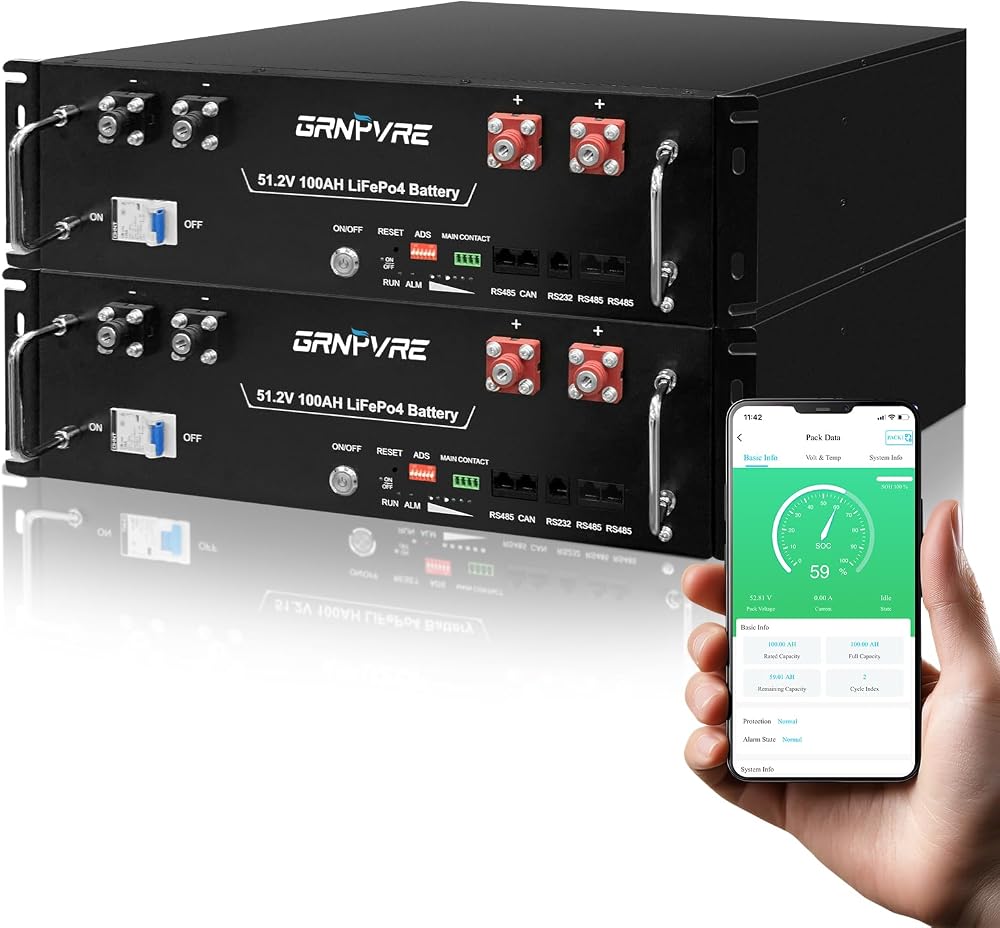
Solar owners, backup power planners, and DIY builders shopping for a 48V LiFePO4 battery need to match the battery to their inverter, load, and climate before they look at price. Based on the listing data, the 48V 100Ah server rack battery (ASIN B0HFWS9QBY) is the best overall pick for most buyers, because it is a finished, sealed unit with a 100A smart BMS and RS485/CAN communication.
No single model fits every system. A good 48V-class battery is a documented 16S pack (51.2V nominal) with a properly rated BMS, charger compatibility, temperature protection, certifications, and a clear warranty. The sections below explain each of those checks and apply them to the five listings.
Quick answer
Most buyers should choose a finished rack battery with a 100A BMS and inverter communication. Builders comfortable with high-current lithium work can save money with a DIY box, but cells are not included and certification is the builder’s responsibility.
- Best for home solar backup: B0HFWS9QBY, finished 5.12kWh rack unit
- Best for DIY builders: B0FGNDLKMV, 16S 200A BMS box
- Best for tight budgets: B0FGNPFMSD, same kit, lower price
Our Winner: 48V 100Ah LiFePO4 Battery, 5.12kWh 3U Server Rack Mount (B0HFWS9QBY)
This listing combines a standard 3U rack enclosure, a built-in 100A smart BMS, RS485, CAN, and RS232 communication, Bluetooth monitoring, and support for up to 32 units in parallel. It is also the lowest-priced finished battery in this group at GBP916.98 in the scraped data. Confirm current pricing, the seller, and the documentation before ordering.
How We Compared These Models
We compared the listings on four criteria: whether the product is a finished battery or an empty enclosure, BMS current rating and communication options, stated capacity and cycle life with the conditions attached, and total installed cost. These matter most because the BMS limits how much power the battery can deliver, and a low sticker price can hide the cost of cells, charger, fusing, and cables. This comparison relies on listed specifications and star ratings only.
| Product | Key Specs | Our Choice | Action |
|---|---|---|---|
| 48V 100Ah 3U Rack Battery (B0HFWS9QBY) | 5.12kWh, 100A BMS, RS485/CAN/RS232, Bluetooth, up to 32 in parallel, 4.5/5, GBP916.98 | Best Overall | |
| 16KWh 48V DIY Battery Box (B0FGNDLKMV) | Empty case, 16S 200A BMS, Bluetooth/CAN/RS485, cells excluded, 5.0/5, $628.00 | Best DIY Kit | |
| 16KWh 48V DIY Battery Box (B0FGNPFMSD) | Same kit contents, 16S 200A BMS, cells excluded, 3.8/5, GBP474.35 | Best Budget | |
| 48V 100Ah 3U Rack Battery (B0HFWND3CT) | Same listing text as the winner, 4.5/5, GBP1,963.13 | Alternate Listing | |
| 48v lifepo4 battery (B0FGXM56DF) | No features or specs in listing data, 4.5/5, price not shown | Verify Before Buying |
Prices in the scraped data appear in a mix of GBP and USD, and they change often. Treat them as a relative guide and check the live price on Amazon.
What Is a 48V Lithium Battery, and Why Is It Rated 51.2V Nominal?
A 48V lithium battery is a high-voltage battery pack used for solar storage, backup power, golf carts, and similar loads. A 48V LiFePO4 battery is usually rated 51.2V nominal because it uses 16 cells in series, and each LiFePO4 cell is nominally 3.2V (16 x 3.2V = 51.2V).
The 48V name is a legacy of lead-acid systems, which use 24 cells at about 2V each. Many inverters and controllers labeled 48V accept the 51.2V LiFePO4 range, but nominal voltage alone does not prove compatibility. Check the input voltage window of your equipment and its charge settings.
For background on the chemistry, see this LiFePO4 chemistry and specifications guide.
How Do You Calculate the Right 48V Battery Capacity?
Multiply nominal voltage by amp-hours to get watt-hours, then reduce by your usable depth of discharge. A 51.2V 100Ah battery stores about 5.12kWh nominally (51.2V x 100Ah = 5,120Wh). At 80% depth of discharge, plan around 4.10kWh before inverter losses.
Here is a worked example for a backup load:
- Average load: 1,000W for 4 hours = 4.0kWh needed.
- One 5.12kWh battery at 80% usable gives about 4.10kWh. That is a thin margin once inverter losses are included.
- Two batteries in parallel give about 8.19kWh usable, which covers the load with room to spare.
Also check power, not just energy. A 100A BMS at about 51.2V can support roughly 5.1kW continuous (51.2V x 100A). A 200A BMS can support roughly 10.2kW. Your inverter surge rating should fit within the BMS peak limit, and a single 100A battery can be the bottleneck for a large inverter.
How Do You Charge a 48V LiFePO4 Battery Safely?
Use a charger or inverter-charger set for 16S LiFePO4 with a constant-current/constant-voltage profile. The upper limit is commonly 3.65V per cell, or about 58.4V for a 16S pack, though some systems use lower absorption settings near 56.8V.
A 100Ah battery is often charged at 20A to 50A (0.2C to 0.5C). LiFePO4 generally should not be charged below 0°C unless the battery has low-temperature protection, internal heating, or thermal management. The LiFePO4 charging guide covers voltage settings in more detail.
Can You Use a Lead-Acid Charger or Solar Charge Controller?
Only if it has a lithium profile or user-adjustable voltage settings that match the battery. Lead-acid profiles often include equalization or float stages that are not suited to LiFePO4. Set absorption to the manufacturer’s value, disable equalization, and confirm the maximum charge voltage stays within the battery’s rating.
How Long Does a LiFePO4 Battery Last?
Published 48V LiFePO4 cycle-life claims commonly range from about 2,000 to 8,000 cycles, depending on depth of discharge, temperature, current, cell quality, and test conditions. At one cycle per day, a 3,000 to 8,000 cycle rating corresponds mathematically to about 8 to 22 years of cycling.
Calendar aging, warranty limits, and the end-of-life capacity definition still apply. The rack battery listings claim up to 15,000 cycles at 80% depth of discharge and a 10 to 15 year service life. That is well above the typical range, and the listing excerpt does not state the test temperature, charge rate, or end-of-life capacity. Treat it as a marketing figure and compare it with the written warranty terms.
How Much Does a 48V Lithium Battery Cost?
The battery price is only part of the cost. A finished rack battery needs a compatible charger or inverter-charger, a fuse or breaker, a disconnect, correctly sized cables, mounting hardware, and installation. A DIY box needs sixteen cells on top of those items.
| Cost Item | Finished Rack Battery | DIY Box Build |
|---|---|---|
| Battery or enclosure kit | Listed price | Listed price |
| 16 matched LiFePO4 cells | Included | Add separately |
| Charger or inverter-charger | Add if not already owned | Add if not already owned |
| Class-T or DC fuse and disconnect | Add | Add |
| Cables, lugs, busbar hardware | Add | Add |
| Rack, cabinet, or enclosure | Add for rack use | Included (steel case) |
| Installation labor or permits | Add if hired | Add if hired |
Use this table as a quote worksheet. The kit listings explicitly exclude cells, so their low prices should not be compared directly with a finished battery.
What Is the Best LiFePO4 Battery for Solar, RV, Backup, or Golf Carts?
For solar and backup power, a finished rack battery with BMS communication to the inverter is the safest default. For RV and off-grid use, a rack unit works if you can mount it and keep it above freezing when charging. Golf carts vary widely in motor controller voltage and current draw, so confirm the cart’s specifications before buying any battery on this list.
None of the five listings provides a cold-weather charging spec in the data supplied. If your battery sits in a garage, shed, or vehicle, ask the seller about low-temperature cutoff or heating before purchase.
In-Depth Reviews

1. 48V 100Ah LiFePO4 Battery, 3U Server Rack (B0HFWS9QBY) – Best Overall
Our Verdict: The best fit for most homeowners who want a ready-to-install 48V battery for solar storage or backup, with inverter communication and room to expand.
The listing describes a 3U enclosure measuring 22.09 x 19.02 x 5.24 inches (56.1 x 48.3 x 13.3 cm) that can be installed in a cabinet or wall-mounted. Capacity is listed as 5.12kWh, which matches the nominal math for a 51.2V 100Ah pack. The listing calls this usable capacity, but at 80% depth of discharge plan around 4.10kWh.
The built-in 100A smart BMS protects against overcharge, over-discharge, over-current, short circuit, and high temperature. RS485 and CAN communication support integration with mainstream inverters, though you should confirm your specific inverter brand and protocol before ordering. Bluetooth monitoring shows voltage, current, state of charge, and cycle count in an app.
The listing says up to 32 units can run in parallel, for over 163.8kWh total. In practice, confirm the parallel limit your inverter and communication setup support. The stated 15,000 cycles at 80% depth of discharge lacks test conditions, so rely on the warranty terms. The data supplied does not list UL 1973, IEC 62619, or UN38.3 certification, so ask the seller for documents.
Why We Like It
- Lowest-priced finished battery in this group in the scraped data
- RS485, CAN, and RS232 communication for inverter integration
- Standard 3U rack format simplifies cabinet installation
- Bluetooth app monitoring of voltage, current, SOC, and cycles
Pros & Cons
Pros
- Finished unit with cells and BMS included
- Expandable in parallel for larger systems
- Fully described protections
- 4.5/5 listing rating
Cons
- 100A BMS limits continuous output to roughly 5.1kW
- No certifications or cold-charging spec in the supplied data
- Cycle-life claim has no stated test conditions

2. 16KWh 48V LiFePO4 Battery Box DIY Kit (B0FGNDLKMV) – Best DIY Kit
Our Verdict: The better choice for experienced builders who want a higher-current 16S BMS and a steel case, and are prepared to source and assemble their own cells.
This is an empty enclosure, not a battery. The listing says it fits 174 x 72 x 207mm Class A LiFePO4 cells in 280Ah, 302Ah, 304Ah, or 314Ah, and recommends EVE 280Ah or 314Ah cells. By the math, 16 cells at 280Ah give about 14.3kWh nominal, and 314Ah cells give about 16.1kWh.
The built-in smart 16S 200A BMS can support roughly 10.2kW continuous at 51.2V, double the rack battery. It supports Bluetooth, CAN bus, and RS485, with temperature protection. The package includes the case, epoxy plate, BMS, communication board, monitor, EVA foam, network cable, screws, busbars, and an M6 socket wrench. The listing notes the white case has wheels and the black case does not.
Building a pack means handling high-current lithium cells, so cell matching, compression, busbar torque, precharge, and short-circuit protection all matter. Review the LiFePO4 storage and safety guide first. A self-built pack will not carry UL 1973 or UL 9540 listings, which can affect insurance and permitting.
Why We Like It
- 200A 16S BMS suits larger inverters
- Steel case with anti-oxidation layer
- Includes busbars, foam, communication board, and monitor
- 5.0/5 listing rating
Pros & Cons
Pros
- Flexible capacity depending on cells chosen
- High BMS current headroom
- Bluetooth, CAN, and RS485 communication
Cons
- Cells are not included
- Requires careful assembly and commissioning
- No product-level safety certification for the finished pack

3. 16KWh 48V LiFePO4 Battery Box DIY Kit (B0FGNPFMSD) – Best Budget
Our Verdict: The lowest entry price for a DIY build, suitable for experienced builders who will verify the contents before committing to cells.
The listing text matches the previous kit: an empty case for 174 x 72 x 207mm cells, a 16S 200A BMS, Bluetooth, CAN bus, RS485, and the same included parts. At GBP474.35 in the data, it costs less than the other kit, but the listing rating is 3.8/5 versus 5.0/5. The data does not explain the difference, so compare the seller, case color, and included components on the product pages.
Budget savings can disappear quickly once you add 16 cells, a charger, fuse, disconnect, and cables. Confirm the BMS manual and communication protocol list before buying cells, since the BMS must match your inverter.
Why We Like It
- Lower entry price for a 16S 200A BMS kit
- Same stated cell compatibility and accessories
- Metal case suited to outdoor or off-grid placement
Pros & Cons
Pros
- Lowest kit price in the data
- High-current BMS
- Communication options included
Cons
- 3.8/5 listing rating is the lowest here
- Cells are not included
- Assembly risk and no finished-pack certification

4. 48V 100Ah LiFePO4 Battery, 3U Server Rack (B0HFWND3CT) – Alternate Listing
Our Verdict: Same stated features as the winner, but listed at GBP1,963.13, more than double the other listing. Buy it only if the seller or bundle justifies the difference.
The title and feature text match B0HFWS9QBY: 5.12kWh, 3U enclosure, 100A smart BMS, RS485, CAN, and RS232, Bluetooth, and up to 32 units in parallel. Specification data is empty, so nothing in the listing explains the price gap. Possible reasons include a different seller, bundle, warehouse, or shipping terms, but the data does not confirm any of them.
Check what is in the box, the warranty provider, and the return policy on both pages. If they match, the lower-priced listing is the better value.
Why We Like It
- Same feature set as the top pick
- Rack format with inverter communication
- 4.5/5 listing rating
Pros & Cons
Pros
- Finished 5.12kWh battery
- Expandable and monitorable
Cons
- Price is more than double the matching listing
- No stated reason for the price difference

5. 48v lifepo4 battery (B0FGXM56DF) – Verify Before Buying
Our Verdict: Not enough information in the supplied data to recommend it over the others. Review the full Amazon page before considering it.
The listing has a 4.5/5 rating, but the data contains no capacity, BMS rating, dimensions, certifications, or price. We cannot confirm whether it is a finished battery, an enclosure, or something else. Before buying, check the amp-hour rating, BMS continuous and peak current, charge voltage, low-temperature protection, communication protocol, certifications, and warranty.
Why We Like It
- 4.5/5 listing rating
- Positioned as a 48V LiFePO4 battery
Pros & Cons
Pros
- Listing rating of 4.5/5
Cons
- No specifications in the supplied data
- Price not available
- Cannot verify BMS, capacity, or certifications
What BMS Rating, Certifications, and Protections Should You Check?
Check continuous and peak BMS current, balancing method, low-temperature cutoff, communication protocol, and parallel limits. Then ask for safety documentation. Depending on the product and its stationary storage use, relevant documents may include UN38.3 for transport, IEC 62619, UL 1973, and UL 9540.
Size the BMS against your inverter. A 48V inverter rated at 5kW can pull around 100A or more from the battery at full load, and surge loads exceed that. A 100A BMS leaves little headroom for a 5kW inverter, while a 200A BMS leaves more.
For a commercial-style overview of 48V system design, see this 48V LiFePO4 guide for PV and low-voltage solar storage.
How Do You Install a 48V LiFePO4 Battery?
Install a correctly rated fuse and a disconnect close to the battery, size cables for the maximum current, and keep the battery in a dry, ventilated, temperature-controlled space. Leave spacing for airflow and service access, and mount rack units securely.
- Fusing: choose a fuse rated for DC at 58.4V or higher, and for the BMS and cable limits.
- Cables: size for continuous current plus a safety margin and keep runs short.
- Precharge: use a precharge resistor before closing the main connection to an inverter with large input capacitors.
- Parallel packs: match voltage before connecting and keep cable lengths equal.
How Do You Build a 48V LiFePO4 Battery Pack, and When Should You Avoid DIY?
Connect 16 matched cells in series, add a 16S BMS, and secure the cells under compression in an insulated enclosure. Avoid DIY if you lack experience with high-current DC, cannot measure cell voltages accurately, or need a certified battery for insurance or code compliance.
- Match cells by capacity and resting voltage before assembly.
- Top-balance the cells to a common voltage.
- Compress the cells to the manufacturer’s recommendation and assemble busbars with torque-controlled fasteners.
- Connect balance leads and BMS wiring, checking polarity at each step.
- Commission with a low-current charge, then verify cell voltages, BMS cutoffs, and communication before full load.
Pre-Purchase Checklist
- Confirm the battery or pack is 16S and note the nominal voltage (51.2V).
- Confirm your charger or inverter supports a 58.4V maximum, or set absorption lower per the manufacturer.
- Check low-temperature charge cutoff or heating if the battery is in a cold space.
- Compare BMS continuous and peak current to your inverter’s maximum draw.
- Verify the parallel limit and communication protocol with your inverter brand.
- Request certification documents (UN38.3, IEC 62619, UL 1973) and read the warranty terms.
- Add charger, fuse, disconnect, cables, enclosure, and installation to the total cost.
Frequently Asked Questions
How much does a 48V lithium battery cost?
In this data, the finished 100Ah rack battery is listed at GBP916.98 in one listing and GBP1,963.13 in another, and DIY kits range from GBP474.35 to $628.00 without cells. Prices change often, so add charger, fuse, disconnect, cables, and installation to get the real total.
How do you charge a 48V LiFePO4 battery?
Use a lithium-compatible charger or inverter-charger with a CC/CV profile, set to about 56.8V to 58.4V for a 16S pack, and avoid charging below 0°C without heating or protection.
What is the best LiFePO4 battery?
Among these listings, B0HFWS9QBY is the best all-around choice for most buyers because it is a finished battery with a 100A BMS and inverter communication. DIY builders needing more current may prefer the 200A BMS kit.
How long will a LiFePO4 battery last?
Cycle-life claims range from roughly 2,000 to 8,000 cycles for typical 48V packs, which is about 8 to 22 years at one cycle per day for 3,000 to 8,000 cycles. Actual life depends on depth of discharge, temperature, current, and warranty terms.
Must a 48V lithium battery match my inverter?
Yes, in practice. Nominal voltage compatibility is not enough. The inverter must accept the 51.2V nominal range, support the charge voltage, and ideally communicate with the BMS over CAN or RS485.
Conclusion
For most buyers, the 48V 100Ah rack battery (B0HFWS9QBY) is the practical choice: it is a finished 5.12kWh unit with a 100A BMS and communication options. Choose a DIY box only if you can source quality cells, build safely, and accept the certification limits. Verify the BMS rating against your inverter, confirm charge voltage and cold-weather limits, and calculate the full installed cost before buying.
Sources
Affiliate Disclosure: As an Amazon Associate, we may earn commissions from qualifying purchases from Amazon.com. This comes at no extra cost to you and helps support our research.