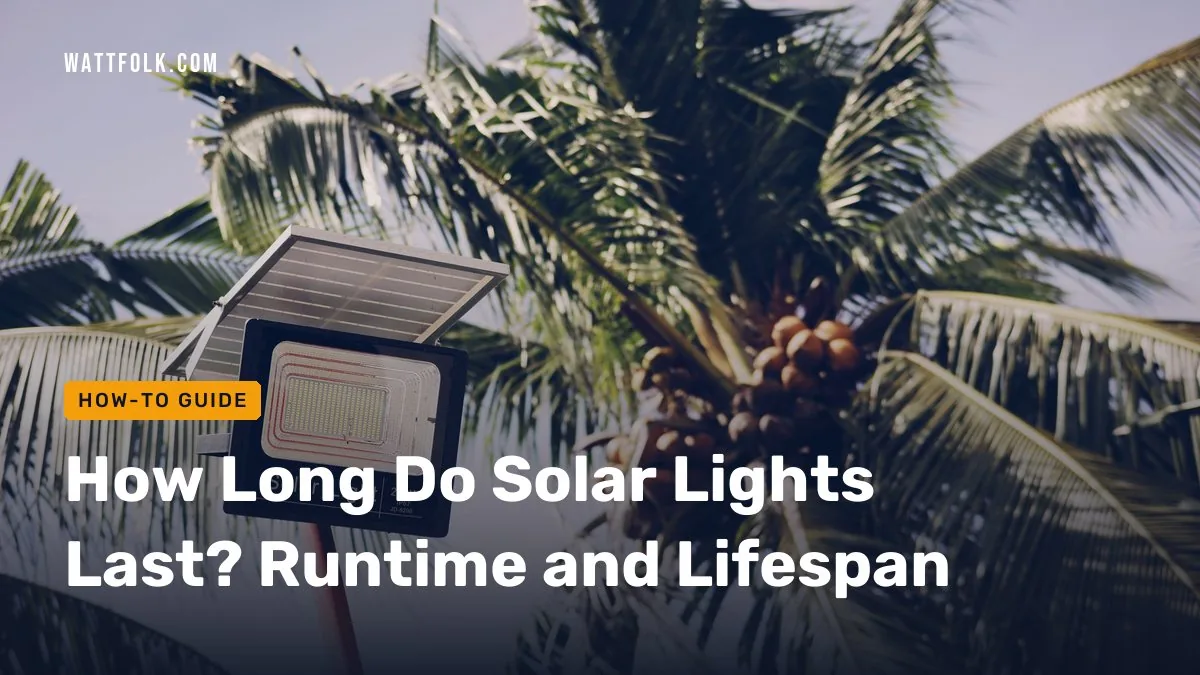
Most small solar lights run about 6 to 12 hours a night after a full day of strong sun. The LED and housing can last several years, but the rechargeable battery usually needs replacing after roughly 1 to 3 years.
Quick answer
Expect 6 to 12 hours of light per night, and 1 to 3 years before the battery fades. The panel inside a garden light is small, so weather and shade cut runtime fast. Larger commercial systems last much longer.
- Best for long life: lights with replaceable batteries
- Best for shady yards: a light with a separate panel
- “Lifespan” is four numbers: nightly runtime, battery life, housing life, and panel life.
- The 8 to 12 hour rating assumes a full charge from a sunny day.
- Batteries fade first. Water and UV damage come next.
- A cloudy day can cut runtime a lot, but panels still make some power in weak light.
- Replacing a battery is often cheaper than replacing the light.
- How long do solar lights last at night?
- How long do solar lights last outside?
- How long does a solar light battery last?
- How much sun do solar lights need?
- How long can solar panels last?
- How long can solar panels last without sun?
- Why do solar lights stop working or get dim?
- Can you replace the battery or panel?
- How to make solar lights last longer
- Troubleshooting by symptom
- What do owners say?
- Frequently Asked Questions
How long do solar lights last at night?
A typical garden light runs 6 to 12 hours after a full charge. That number is a best case, not a promise. It assumes a clear, sunny day, a clean panel, and a healthy battery.
Brightness settings matter too. A light that flashes or runs in a high mode drains the battery sooner. Security lights with motion sensors often use more power in short bursts, so a rated runtime may not match real use.
Worked example: sunny day versus cloudy day
These numbers are assumptions to show the idea. Real lights vary.
- Rated runtime: 10 hours after a full sunny charge.
- Cloudy day: if the panel only fills about half the battery, runtime drops to roughly 5 hours.
- Aged battery: if the battery has lost 40% of its capacity, a full charge gives about 6 hours.
- Both together: a half charge on a 60% battery gives about 3 hours.
The math is simple: rated hours × share of charge × share of battery capacity left. So 10 × 0.5 × 0.6 = 3 hours.
How long do solar lights last outside?
Most cheap garden lights last one to three years outdoors. Better ones can last longer. Owner reports mention some units dimming or failing within months, while others run for years. Moisture and UV-damaged covers are common problems.
Each part ages at its own pace. The LED often outlives everything else. The battery fades first. The plastic housing yellows and cracks in strong sun. Seals let in water over time.
| Light type | Typical nightly runtime | Battery replacement | Outdoor service life | Panel life |
|---|---|---|---|---|
| Pathway | 6 to 10 hours | About 1 to 3 years | 1 to 4 years | Often outlasted by the housing failing |
| Decorative / string | 6 to 8 hours | About 1 to 2 years | 1 to 3 years | Often outlasted by the housing failing |
| Security / motion | Varies with motion use | About 2 to 4 years | 2 to 5 years | Several years, if sealed well |
| Commercial street light | Dusk to dawn | 3 to 5 years (gel or AGM) | Designed for about 20 years | 20+ years |
The consumer rows are general estimates based on typical battery types and owner reports, not lab results. The commercial figures come from a solar street lighting system maker.

How long does a solar light battery last?
Small rechargeable batteries in garden lights commonly need replacing after about 1 to 3 years. Each night the battery charges and drains, and every cycle wears it a little. Heat and freezing speed this up.
Many cheap lights use small NiMH or NiCd cells. Some newer ones use lithium types. In commercial systems, standard gel or AGM batteries may need replacing every 3 to 5 years, according to that same street-lighting maker. One LiFePO4 example is estimated at about 7 years and can give about three days of dusk-to-dawn backup in suitable conditions.
How much sunlight do solar lights need to charge fully?
Most need a full day of direct sun, often about 6 to 8 hours of bright daylight. In the US, that works best in open spots in summer. Winter days are shorter and the sun sits lower, so runtime drops.
Shade is the biggest charging killer. Even a tree branch across part of the panel can cut charge a lot. Dust, pollen, and water spots also block light. A panel tilted away from the sun loses more.
Will solar lights charge on cloudy or rainy days?
Yes, but less. A panel can still make some power in weak or indirect light. The problem is that the small battery may not collect enough for a full night. Expect shorter, dimmer light after a few gray days.
How long can solar panels last?
Well-built residential panels commonly last 25 to 30 years or more, and manufacturers often give 25-year performance warranties, as pv magazine USA reports. NREL notes that modules built today are generally expected to run about 30 years, and its research on module lifetime looks at lifetimes up to 50 years.
That is for rooftop panels. The tiny panels on garden lights are different. They are cheaper and usually fail from cracked covers or water, not from slow aging.
How panel output fades
Panels typically lose about 0.5% to 1% of output per year. NREL describes about 20% loss as a common point where a module may no longer give enough power.
- Assumption: 0.5% loss per year.
- After 20 years: 20 × 0.5% = 10% lost.
- The panel still makes about 90% of its original output.
At 1% per year, the same panel would sit near 80% after 20 years.
How long can solar panels last without sun?
A panel does not stop working when the sun goes away. It just makes less power in weak light, and nothing at night. For a small light, the battery carries the load. Once it runs empty, the light goes dark until the panel recharges it.
A garden light with a small battery may manage one night after a poor day, maybe less. Large commercial systems with big batteries can cover multiple days. The LiFePO4 example above offers about three days of backup in suitable conditions.

Why do solar lights stop working or become dim?
The usual causes are a worn battery, a dirty or shaded panel, and water inside the housing. Owners also report brittle plastic covers after long UV exposure.
- Water ingress: enters through seams, covers, or control boxes. It corrodes contacts and shorts the circuit.
- UV damage: clouded or cracked covers let in water and block light.
- Corrosion: rusty battery contacts stop charging.
- Freezing: cold weather cuts battery capacity and can crack cheap housings.
- Heat: hot spots speed up battery wear.
From the Shop
Based on patterns in owner reviews, a light that works for a few months and then dims is rarely an LED problem. Look at the battery and the contacts first.
Can a solar light battery or panel be replaced?
Often the battery can, and it is the best fix. Open the battery door and check the cell type and voltage printed on it. Match both. The panel is usually sealed in and not worth replacing on cheap lights.
If the light is dim but the housing is sound, replace the battery.
If the housing is cracked or full of water, replace the light.
If the light is a pricier model with a separate panel, repair or swap the parts.
If the light costs only a few dollars, replacement is usually simpler.
Keep any wiring work low-voltage and on the light itself. Never use extension cords to power or charge an outdoor solar fixture. If a larger system ties into house wiring, hire a licensed electrician.
How can solar lights be made to last longer outdoors?
- Place the panel in open sun, facing south in most of the US.
- Wipe the panel every month or two with a damp cloth.
- Swap the battery every year or two.
- Clean battery contacts if they look dull or crusty.
- Bring cheap lights inside during hard freezes.
- Check seals and covers each season.
- Choose models with replaceable batteries and sealed housings.
Troubleshooting by symptom
| Symptom | Likely cause | What to try |
|---|---|---|
| Dim light | Old battery, dirty panel | Clean the panel. Replace the battery. |
| Short runtime | Shade, cloudy weather, weak battery | Move to full sun. Test after a clear day. |
| No charging | Switch off, corroded contacts, dead battery | Turn it on. Clean contacts. Swap the battery. |
| Flickering | Loose contacts, low charge, moisture | Reseat the battery. Dry the unit fully. |
| Water damage | Failed seal or cracked cover | Dry it out and reseal. Replace if corroded. |
Repair or replace: what makes financial sense?
A new battery often costs a few dollars. If the rest of the light is in good shape, that is the better buy. For a light that costs about the same as two batteries, or has water damage, a new light makes more sense. Higher-priced lights with replaceable parts are usually worth fixing.
What do owners say?
Owners like
- Easy installation without wiring or an electrician
- Automatic dusk-to-dawn operation
- Useful decorative or pathway lighting after adequate sun
- Longer service life when replacement batteries are available
- Responsive replacement support from some manufacturers
Common complaints
- Lights become dim or run for fewer hours after several months
- Units stop working prematurely despite being advertised for outdoor use
- Water enters through covers, seams, or control boxes
- Plastic covers become brittle or fail after prolonged UV exposure
- Replacement batteries or replacement parts are difficult to find
Summarised from owner reviews and long-term user reports; individual experiences vary.
Frequently Asked Questions
How long do solar lights last?
The LED and housing may last several years. The battery usually needs replacing after about 1 to 3 years. Commercial systems can last around 20 years.
How long do solar lights last at night?
Most run about 6 to 12 hours after a full sunny day. Clouds, shade, and an old battery can cut that sharply.
How long do solar lights last outside?
Cheap units often last 1 to 3 years outdoors. Better sealed models with replaceable batteries can last longer.
How long can solar panels last?
Residential panels commonly last 25 to 30 years or more. Output drops about 0.5% to 1% per year.
How long can solar panels last without sun?
The panel itself is fine without sun. A small light runs on its stored battery, usually for one night at most. Large systems with big batteries can run about three days.
How long will solar panels last?
Expect around 25 to 30 years for quality home panels, with about 90% output left after 20 years at a 0.5% yearly loss.
How long does solar lights last?
It depends on the part. Runtime is hours per night, the battery lasts 1 to 3 years, and the whole light often lasts a few years.
How long does solar panels last?
Panels outlast almost every other part of a solar system. Home panels often run 25 to 30 years or more, while the tiny panels in garden lights usually fail from water or cracked covers first.
Sources