
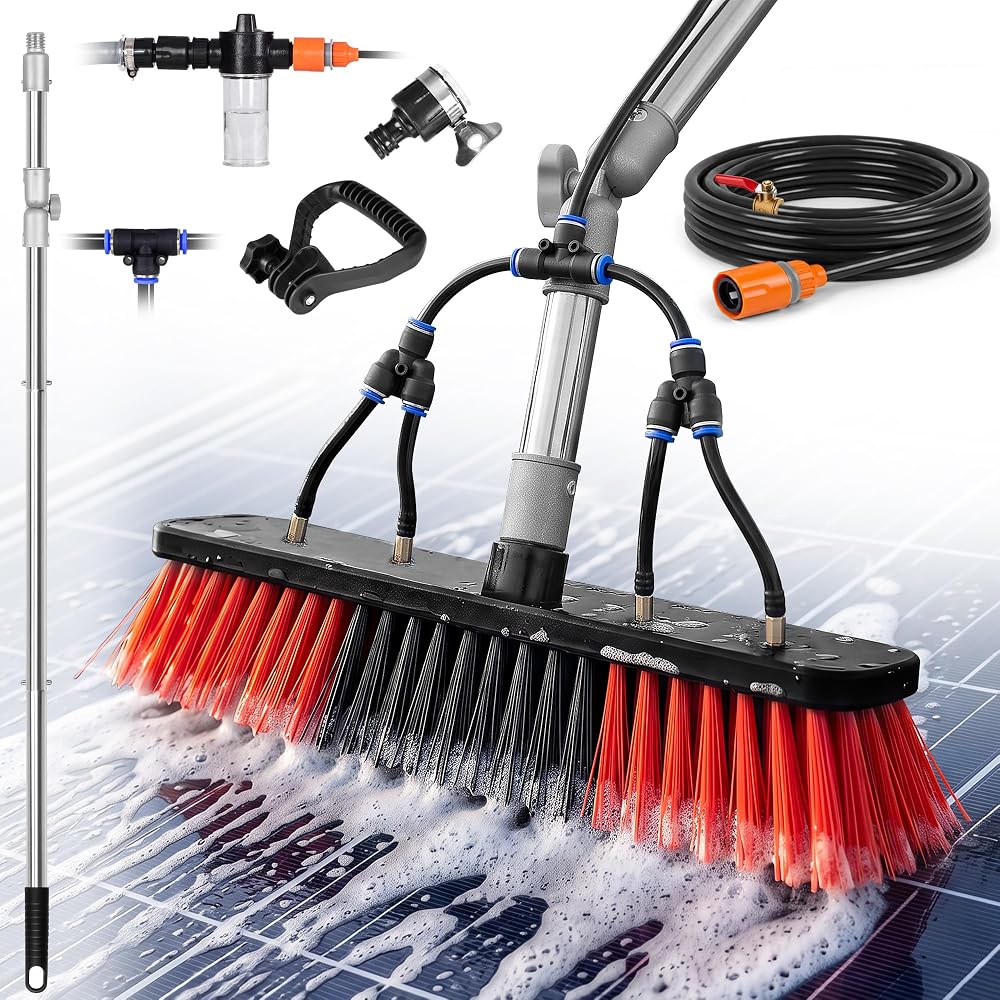
Homeowners with rooftop solar who want to clean panels from the ground, without scratching the glass or climbing onto the roof, need a soft-bristle brush on an extension pole fed with low-pressure clean water. For most accessible arrays that is the best-value setup, and a hardware-store DIY kit can be adequate, while a complete professional deionised-water system can cost thousands.
Quick answer
Choose a soft-bristle water-fed brush on a pole that reaches your highest panel, and rinse with low-pressure clean water. Check the panel maker’s cleaning instructions first. Skip pressure washers and harsh chemicals.
- Best for low single-storey roofs: 12 FT Soft Bristles kit, lowest kit price
- Best for taller single-storey roofs: 15FT Stainless Steel kit
- Best for two-storey homes: 40ft Rotatable Brush and Squeegee kit
Our Winner: Soft Bristles Solar Panel Cleaning Brush, 12 FT Solar Panel Cleaner Kit
Based on the listing, this is the lowest-priced complete water-fed kit in this group at GBP 56.64, and it carries a 4.0 out of 5 rating on Amazon. It pairs a soft-bristle water-fed brush with an extendable long handle, which matches the core method for accessible panels. Its 12 FT reach suits low single-storey arrays, so measure your roof height before ordering.
How We Compared These Models
This comparison is based on listing specifications and Amazon star ratings, not hands-on testing. The criteria that matter most are pole reach versus your roof height, bristle softness and brush head design, hose length and flow control, and whether the kit is a complete tool set or only a cleaning liquid. Price relative to a one-off professional clean is the final check.
Prices below are the figures shown in the product data (listed in GBP). Confirm the current price and shipping to your location on Amazon before buying.
| Product | Key Specs | Our Choice | Action |
|---|---|---|---|
| 12 FT Soft Bristles Solar Panel Cleaner Kit | 12 FT extendable handle, water-fed brush, soap dispenser, GBP 56.64, 4.0/5 | Best Overall | |
| 15FT Stainless Steel Water-Fed Pole Brush Kit | 15FT pole, 13.8 in brush, 4 outlets, 32.8FT hose, GBP 67.97, 3.0/5 | Best for Single-Storey Reach | |
| 40ft Water Fed Pole Kit with Rotatable Brush and Squeegee | 3.3 to 40 ft aluminum pole, squeegee, 2 dusting brushes, 20 m hose, GBP 173.72, 4.0/5 | Best Premium | |
| 26FT Water Fed Pole Kit, Window Solar Panel Brush and Pole | 26FT pole, brush included, GBP 135.20, 3.3/5 | Best Mid-Height Reach | |
| Solar Shine Solar Panel Cleaner and Protectant | 32 fl. oz. concentrate, sprayer, GBP 37.73, 4.0/5 | Best Cleaning Solution |
In-Depth Reviews

1. Soft Bristles Solar Panel Cleaning Brush, 12 FT Kit – Best Overall
Our Verdict: The simplest and cheapest route to the recommended method: soft bristles, an extendable handle and water fed through the brush. It fits low single-storey arrays.
The listing describes soft bristles, a water-fed brush, an extendable long handle and a soap dispenser. At GBP 56.64 it undercuts every other pole kit here, and its 4.0 rating is tied for the highest among the kits. The listing does not publish bristle material, hose length or pole construction, so those details are worth checking on the Amazon page.
The 12 FT length is the limit. Using the pole calculation below, it suits roughly 9 to 10 ft panel heights. The soap dispenser is optional: use it only if the panel maker permits detergent, and otherwise rinse with plain water.
Why We Like It
- Lowest price among the complete pole kits
- Soft bristles and water-fed design match the manufacturer-style guidance for gentle cleaning
- Extendable handle lets you store it compactly
Pros & Cons
Pros
- Best price for a complete kit
- 4.0/5 Amazon rating
- Doubles for car, RV and window washing
Cons
- 12 FT reach is short for steeper or taller roofs
- Few published specifications

2. 15FT Solar Panel Cleaning Brush Kit, Stainless Steel Water-Fed Pole – Best for Single-Storey Reach
Our Verdict: The most fully specified kit in the group, with enough pole and hose for a typical single-storey array. Its 3.0 rating is the lowest here, so read the current reviews first.
The listing describes a 35 cm (13.8 in) brush with four water outlets, soft bristles with no exposed hard edges around the perimeter, and a snap-button stainless steel pole that extends to 15FT. A 32.8FT hose with pole clips and a flow-control valve is included. The brush angles through 180 degrees for flat, sloped or vertical surfaces.
Based on the specifications, the wide brush and four outlets mean fewer passes across each panel. The 3.0/5 rating is a caution. Verified buyer reviews are the best place to check pole flex, joint durability and brush-head fit before you commit.
Why We Like It
- 15FT reach covers many single-storey arrays
- Four-outlet brush wets more glass per pass
- Hose clips and flow valve improve control
Pros & Cons
Pros
- Detailed, transparent feature list
- Adjustable 180 degree brush angle
- Hose included
Cons
- 3.0/5 rating is the lowest of the group
- Stainless steel pole is conductive, so stay clear of power lines

3. 40ft Water Fed Pole Kit, Rotatable Brush and Squeegee – Best Premium
Our Verdict: The only kit here with enough reach for most two-storey homes, and the only one that includes a squeegee for hard-water areas.
The listing describes an aluminum pole adjustable from 3.3 to 40 feet, a rotatable 13.8 in brush head, a 20 m water pipe, a squeegee and two dusting brushes. Aluminum keeps the weight down, which matters because a long pole is tiring to hold steady at full extension.
The squeegee gives you a way to remove rinse water without a deionised system, which reduces mineral spotting in hard-water areas. At GBP 173.72 it costs the most of the five, but it remains a small fraction of a professional trolley system. Aluminum conducts electricity, so never use a long pole near overhead power lines.
Why We Like It
- Up to 40 ft working length
- Squeegee and extra dusting brushes included
- Rotatable head helps with angled panels
Pros & Cons
Pros
- Longest reach of the group
- Squeegee suits hard-water finishing
- 4.0/5 Amazon rating
Cons
- Highest price here
- Long poles are hard to control and increase risk near a two-storey roofline

4. 26FT Water Fed Pole Kit, Window Solar Panel Cleaning Brush and Pole – Best Mid-Height Reach
Our Verdict: A middle option for taller single-storey roofs or low second-storey arrays, held back by limited listing detail and a 3.3 rating.
The listing title describes a 26FT water-fed pole with a brush for windows and solar panels. No feature list or specifications were available in the product data, so bristle type, hose length and pole material are unconfirmed. Check these on the Amazon page before purchase.
At GBP 135.20 it costs less than the 40 ft kit, but the 3.3/5 rating and sparse detail make it harder to recommend. Choose it only if your measured pole length falls between 17 and 26 ft and the 40 ft kit is more than you need.
Why We Like It
- 26FT reach fills the gap between the 15FT and 40ft kits
- Water-fed brush design
Pros & Cons
Pros
- Reaches taller single-storey arrays
- Priced below the 40 ft kit
Cons
- Few published specifications
- 3.3/5 rating

5. Solar Shine Solar Panel Cleaner and Protectant – Best Cleaning Solution
Our Verdict: A cleaning liquid, not a kit. It only makes sense as an add-on to a pole and brush, and only if your panel maker allows it.
- Manufacturer: Brybrad
The listing describes a 32 fl. oz. concentrate for up to 20 panels or about 300 sq. ft., with a sprayer said to reach up to 30 feet. It states the formula is non-toxic, biodegradable and free of VOCs, solvents and ammonia. The listing also advises scrubbing with a nylon brush after application.
The manufacturer claims it can increase energy output by up to 30% on properly cleaned panels. Treat that as a marketing claim: the gain depends on how dirty the panels were, and cleaning cannot restore output beyond a panel’s clean baseline. Because warranties can depend on approved cleaning methods, confirm the product is acceptable to your panel maker before using it.
Why We Like It
- Targets bird droppings, tree sap and hard water stains per the listing
- Concentrate stretches across several cleans
- Lists no ammonia or solvents
Pros & Cons
Pros
- Lowest outlay of the five
- Sprayer lets you apply it from the ground
Cons
- No brush or pole included
- Efficiency claims are manufacturer statements
- May not be covered by your panel warranty
What Should a Solar Panel Cleaning Kit Include?
A workable kit has a soft-bristle brush or microfiber head, an extension pole, and a way to deliver clean water at low pressure. Everything else is an upgrade.
Shopping checklist
- Essential: soft, non-abrasive brush or microfiber head
- Essential: pole that reaches your highest panel (see the calculation below)
- Essential: hose with a flow-control valve, run at low pressure
- Optional: squeegee for hard-water areas
- Optional: spare brush heads, since worn bristles can trap grit
- Optional: deionised (DI) filter and TDS meter, mainly for professionals or very hard water
Is a Soft Brush and Garden Hose Enough to Clean Solar Panels?
For most residential systems, yes. Manufacturer guidance summarized by Australian cleaning sources recommends soft, non-abrasive brushes and clean water, and warns that hard or abrasive tools can scratch the panel surface. The method matters more than a branded solar cleaner: soft bristles, low pressure, cool panels and the maker’s instructions.
Do I Need Deionised or Distilled Water?
Usually not. Deionised water reduces mineral spotting, but a soft brush and clean water may be sufficient for many homes. Consider it if you live in a hard-water area and see white residue after rinsing. A squeegee, as included with the 40ft kit, is a cheaper way to limit spotting than a DI filter.
Can I Use a Pressure Washer, Detergent, or Household Glass Cleaner?
Avoid pressure washers, bleach, ammonia and harsh chemicals, which can damage panels or their components. Use detergent or specialty cleaners only if your panel maker approves them. Household glass cleaners often contain ammonia, so skip them.
What Brush and Pole Length Are Suitable for a Single-Storey or Two-Storey Home?
Measure the height from the ground to the top edge of your highest panel, then add a 25% allowance for the pole angle and the horizontal setback from the wall. These are illustrative planning figures, not manufacturer specifications.
| Home | Highest panel edge | Calculation | Pole needed | Matching kit here |
|---|---|---|---|---|
| Low single-storey | 10 ft | 10 x 1.25 = 12.5 | About 13 ft | 15FT kit (12 FT is marginal) |
| Tall single-storey | 13 ft | 13 x 1.25 = 16.25 | About 17 ft | 26FT kit |
| Two-storey | 22 ft | 22 x 1.25 = 27.5 | About 28 ft | 40ft kit |
For two-storey homes, a pole over 25 ft is heavy and hard to control at the tip. If the array sits above a steep or hard-to-reach roofline, professional cleaning is often safer.
Can I Buy a Solar Panel Cleaning Kit at Bunnings, and How Much Does It Cost?
Bunnings stocks general cleaning tools such as telescopic poles, soft brushes, hoses and squeegees, so a DIY kit can be assembled there. A dedicated solar kit is not something this article can confirm, and current prices vary by store and stock, so check the Bunnings website and add up each component. A professional setup is far more expensive: Blue Tongue Industries lists a solar cleaning kit with a 24 ft carbon-fibre pole, a 56 cm brush with six jets, a 50 m hose, DI resin, a TDS meter and 25 L of mixed-bed resin at AUD 3,376 excluding GST.
| Setup | Best use | Reach | Included parts | Indicative cost |
|---|---|---|---|---|
| Basic Bunnings-style DIY | Low single-storey, occasional rinse | Depends on pole chosen | Soft brush or microfiber head, telescopic pole, hose, optional squeegee | Check current Bunnings prices and total each part |
| Extendable water-fed kit | Single-storey to two-storey homes | 12 to 40 ft | Water-fed brush, pole, hose | GBP 56.64 to 173.72 (listed) |
| Professional DI trolley kit | Cleaning businesses, large arrays | 24 ft pole (example) | Carbon-fibre pole, jetted brush, 50 m hose, DI resin, TDS meter | AUD 3,376 excl. GST (example) |
The total cost of a DIY setup includes more than the pole. Count the brush head, hose, squeegee and spare heads. Pre-assembled water-fed kits bundle most of these items.
Worked Example: A 6.6 kW Rooftop Array
A 6.6 kW system typically has around 16 to 18 panels, which is an assumption for this example. A single-storey home with panels about 13 ft high needs roughly a 17 ft pole by the calculation above. Using the 26FT kit at GBP 135.20, or the 15FT kit at GBP 67.97 if your panels sit lower, gives you a reusable setup.
Compare that with a single professional clean by getting local quotes, then divide the kit price by the quote to find the break-even number of cleans. For illustration only, if a quote were 150 in the same currency as the kit, the 15FT kit at 67.97 would pay for itself within the first clean. The professional kit at AUD 3,376 only makes sense for people cleaning many roofs.
Safe Cleaning Method for Dust, Bird Droppings and Grime
- Read the panel maker’s cleaning instructions first, because unsuitable tools or chemicals can affect warranty coverage.
- Clean early in the morning or on a cool day, since cold water on hot glass raises thermal-stress risk.
- Rinse loose dust first, then brush gently with low-pressure water.
- For bird droppings, soak with clean water to loosen them before brushing instead of scrubbing dry.
- Rinse thoroughly, and squeegee if you see mineral spots.
The Shine Panel Care Australian solar cleaning guide covers similar steps in more detail.
When Should I Hire a Professional Instead of Cleaning the Panels Myself?
Hire a professional if your roof is sloped or difficult, if access needs fall protection, or if the array is out of safe pole reach. Do not walk on panels, and do not use a pole near overhead power lines. Also call a professional if you see cracked glass, loose wiring or damaged components. Cleaning is unnecessary after regular rain in low-dust areas.
Frequently Asked Questions
What is a solar panel cleaning kit?
It is a set of tools for washing panels from the ground: typically a soft brush, extension pole, hose and sometimes a squeegee. Professional kits add deionised-water components.
Can I buy a solar panel cleaning kit at Bunnings?
You can assemble one from Bunnings tools such as a telescopic pole, soft brush and hose. Check the current range online, since stock varies and a ready-made solar kit may not be listed.
How much does a solar panel cleaning kit cost at Bunnings?
Current Bunnings prices are not verified here, so total each part on their site. For comparison, the Amazon pole kits above list at GBP 56.64 to 173.72, and a professional DI kit is AUD 3,376 excluding GST.
How often should solar panels be cleaned?
It depends on dust, bird activity and rainfall. Many homeowners clean once or twice a year, and more often in dusty or bird-heavy locations. Check your panel maker’s guidance.
Do I need to turn the system off before cleaning?
Follow your panel and inverter maker’s instructions. Those instructions, not general advice, should decide any shutdown steps.
Conclusion
For most homes with accessible panels, a soft-bristle water-fed pole kit with clean, low-pressure water is the best value. The 12 FT Soft Bristles kit is our overall pick for low roofs, the 15FT stainless kit suits taller single-storey arrays, and the 40ft kit with squeegee covers two-storey homes. Match pole length to your measured roof height, check your panel maker’s instructions, and hire a professional when the roof or access is unsafe. For background on maintenance practice, the Industry Best Practice Manual is a useful reference.
Sources
Affiliate Disclosure: As an Amazon Associate, we may earn commissions from qualifying purchases from Amazon.com. This comes at no extra cost to you and helps support our research.