

The most common mistake with RV solar is buying panels by nameplate wattage without first adding up daily watt-hours. Start with your loads instead: for most RVs, rigid monocrystalline panels paired with an MPPT charge controller are the best overall choice, with 200 to 400 W covering basic loads and roughly 600 to 1,200 W or more needed for full-time boondocking.
This guide compares five panels and kits from Amazon, from a 20 W battery maintainer to a 450 W portable panel. It also includes a worked sizing calculation, wiring advice, and troubleshooting steps. The analysis is based on product specifications, listing details, and patterns in verified buyer feedback.
Quick answer
Rigid monocrystalline roof panels with an MPPT controller suit most RVs. Divide daily watt-hours by peak sun hours, then add 25 to 30 percent for losses. Of these five, the ECO-WORTHY kit best matches that roof-mounted approach.
- Best for a roof starter system: ECO-WORTHY 200W kit
- Best for high-output portable power: ZOUPW 450W PRO
- Best for light weight: ZOUPW 230W Bifacial
Our Winner: ECO-WORTHY 200 Watts 12 Volt/24 Volt Solar Panel Kit with 30A PWM Charge Controller
This is the only roof-mount style kit in the group. It includes two 100 W monocrystalline panels, Z mounting brackets, a 30A controller, and 16.4 ft of 10 AWG cable. The listing states it produces 800 Wh per day under four hours of full sun, which fits lights, a 12V fridge, fans, and device charging. The main trade-off is the PWM controller, which is less efficient than MPPT.
How We Compared These Models
We compared the products on four criteria: usable wattage, mounting style (fixed roof or portable), controller and connector compatibility, and durability ratings such as wind load, snow load, and ingress protection. These criteria come from the listed specifications and from what verified buyers most often discuss. This guide draws on published specs only.
| Product | Key Specs | Our Choice | Action |
|---|---|---|---|
| ECO-WORTHY 200W Kit | 2 x 100W mono, 30A PWM controller, Z brackets, 12V/24V, listed at $189.99 | Best Overall | |
| ZOUPW 450W PRO Bifacial | 450W, N-Type, 20.9 lbs, Voc 46.0V, 4-zone anti-shading, IP68 | Best Premium | |
| Renogy 200W Portable | 200W, 25% efficiency, made for power stations | Best Mid-Range Portable | |
| ZOUPW 230W Bifacial | 230W, N-Type, 12.6 lbs, 5-in-1 cable, IP68 | Best for Portability | |
| SOLPERK 20W Kit | 20W, smart MPPT controller, adjustable bracket, trickle charger | Best Budget |
In-Depth Reviews

1. ECO-WORTHY 200W Solar Panel Kit – Best Overall
Our Verdict: The best starting point for a travel trailer or van that needs fixed, always-on charging for lights, a fridge, and electronics.
Based on the listing, the kit uses monocrystalline cells rated at up to 21.5% efficiency. The panel frame is corrosion-resistant aluminum, rated for 2400Pa wind and 5400Pa snow load, with an IP65 junction box. Pre-drilled backs and plug-and-play cables simplify installation. The listed panel size is 35.2 x 23.1 x 1.37 in.
The kit can be wired in series for 24V or in parallel for 12V. That flexibility matters because a PWM controller needs panel voltage matched to battery voltage. Buyers who later want more output can swap the PWM controller for an MPPT model, though that adds cost.
Why We Like It
- Complete package with panels, brackets, controller, and 16.4 ft of 10 AWG cable
- Rigid glass-and-aluminum construction suited to permanent roof mounting
- 12V or 24V wiring options
- Listed 800 Wh per day under four full sun hours
Pros & Cons
Pros
- Lowest entry price among the true roof-mount options here
- High 4.6 rating on Amazon
- Pre-drilled panels and Z brackets included
Cons
- PWM controller wastes some panel output compared to MPPT
- Only 200 W, so it will not cover heavy loads or air conditioning
- One-year warranty is shorter than the 36 months on the ZOUPW panels

2. ZOUPW 450W PRO Bifacial Portable Solar Panel – Best Premium
Our Verdict: The highest-output option here, aimed at campers who pair a large portable power station with a panel they can move into the sun.
The manufacturer lists N-Type 16BB monocrystalline cells at 25.6% efficiency and a bifacial design with rear gain of up to 30% on snow and 20% on sand. Rear gain depends on ground reflectivity, so treat it as a best-case figure.
The 4-zone parallel layout is designed to reduce losses from partial shade. That is a practical advantage at campsites with tree cover. At 20.9 lbs, it is lighter than the 29.5 lbs the listing cites for standard 450W panels.
Compatibility needs checking. The panel has an open-circuit voltage (Voc) of 46.0V and the listing specifies a 40 to 60V input range. Confirm that your power station accepts that range before buying. The 5.0 rating looks strong, but the data does not show how many reviews support it.
Why We Like It
- Highest wattage of the five, which shortens recharge time for large batteries
- 4-in-1 cable with Anderson, XT60, DC7909, and DC8020 connectors
- 13.12 ft 12AWG extension cable and four ground stakes included
- IP68 rating, 2400Pa wind and 5400Pa snow load per the listing
- 36-month warranty and 30-day money-back guarantee
Pros & Cons
Pros
- Strong output for fast station charging
- Shade-mitigating circuit layout
- Foldable with kickstands and a carry bag
Cons
- Highest price in this group
- Voltage window limits compatibility with smaller stations
- Not a permanent roof mount, and it needs setup at each camp
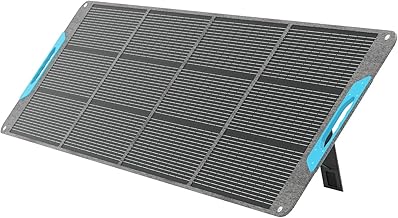
3. Renogy 200W Portable Solar Panel – Best Mid-Range Portable
Our Verdict: A balanced 200 W portable panel for campers who want a recognized solar brand and a simple power-station setup.
The listing title states 25% efficiency and compatibility with power stations. The product data supplied no feature list or specifications, so details such as weight, connectors, and warranty should be checked on the Amazon page before purchase.
Its 4.5 rating suggests generally positive buyer experience. At 200 W, it suits weekend trips and moderate loads, but it is not a fit for a hardwired roof system without a separate controller and wiring plan.
Why We Like It
- 25% efficiency per the listing title
- 200 W output in a portable format
- Moves out of RV shade into direct sun
Pros & Cons
Pros
- Well-known brand in RV and off-grid solar
- Portable, so placement can follow the sun
- 4.5 rating
Cons
- Limited detail in the supplied listing data
- Requires a compatible power station or controller
- Less output than the 450W ZOUPW

4. ZOUPW 230W Bifacial Portable Solar Panel – Best for Portability
Our Verdict: The easiest panel here to carry and set up, suited to campers with a mid-sized power station.
The panel weighs 12.6 lbs, which the listing says is 66% lighter than glass alternatives. It uses N-Type 16BB cells with a stated 25% conversion rate and a bifacial design. The manufacturer says it can produce over 1 kWh per day in peak sun. That is a best-case figure, since 230 W over five ideal hours is about 1.15 kWh before losses.
It ships with a 10 ft 5-in-1 adapter cable and a storage bag. The listing rates it IP68 and for heat up to 140°F, with a 36-month warranty. Buyers should still confirm the connector and voltage match their power station.
Why We Like It
- Light enough to carry and store easily
- 5-in-1 cable covers many power station inputs
- Bifacial gain on bright ground such as sand or snow
- 36-month warranty
Pros & Cons
Pros
- Very low weight for 230 W
- Tri-fold design with storage bag
- Waterproof IP68 rating
Cons
- Composite surface is not the same as rigid glass for long-term roof use
- Rear gain claims depend on ground type
- Not a permanent solution for full-time off-grid living

5. SOLPERK 20W Solar Panel Kit – Best Budget
Our Verdict: A low-cost maintainer for keeping a starter or stored battery topped off. It is not an RV power system.
This kit combines a 20 W panel, a smart MPPT controller, and an adjustable mount bracket. It is described as a waterproof trickle charger. At 20 W and five peak sun hours, the theoretical maximum is about 100 Wh per day, before losses. That is enough to offset self-discharge on a parked RV battery, but it will not run a fridge or recharge a deeply drained house bank.
The product data supplied no feature list, so check the listing for cable length and battery compatibility.
Why We Like It
- Very low price
- Includes an MPPT controller, unusual at this size
- Adjustable bracket for aiming at the sun
Pros & Cons
Pros
- Inexpensive way to prevent battery self-discharge
- Smart controller included
- 4.5 rating
Cons
- Far too small for daily RV loads
- Not suited to large lithium house banks
- Limited detail in the supplied listing data
How Do RV Solar Panels Work?
RV solar panels convert sunlight into direct current, which a charge controller regulates before it reaches the battery bank. The batteries then feed 12V loads directly or feed an inverter for 120V AC appliances.
The chain has five parts:
- Panels: produce DC power in proportion to sunlight and angle.
- Charge controller: limits voltage and current so the battery is charged safely.
- Batteries: store energy for night and cloudy periods.
- Inverter: converts battery DC to AC for outlets.
- Loads: everything that draws power, from LED lights to a microwave.
Panel wattage is not the same as usable household power. Anything running on AC must pass through an inverter, which adds its own losses, and the battery bank must be large enough to supply the draw.
What Type of Solar Panel Is Best for an RV?
Rigid monocrystalline panels are the best overall choice when your roof has room. They generally deliver strong, consistent output and better durability. Flexible and portable panels solve different problems.
| Factor | Rigid | Flexible | Portable |
|---|---|---|---|
| Output | Close to rating when cool and well aimed | Owners commonly report about 50 to 80% of rating in practice | Good, and can be aimed at the sun |
| Durability | Best, glass and aluminum frame | Reports of delamination, bubbling, cracking, or yellowing after one to two years | Moderate, depends on handling |
| Weight | Heaviest | Lightest | Light to moderate |
| Installation | Brackets and roof drilling | Adhesive or low-profile mount | None, plug in and aim |
| Shade tolerance | Fixed, so roof shade hurts | Poor in heat or partial shade | Best, move it out of shade |
| Roof suitability | Flat roofs with clearance | Curved or weight-limited roofs | Not roof dependent |
| Cost | Lowest per watt | Higher per watt | Highest per watt, but flexible use |
Flexible panels sit directly on the roof with little airflow, which raises cell temperature and reduces output. For a deeper look at one popular flexible model, see this Renogy 100W flexible panel review for RVs.
How Many Watts of Solar Panels Does an RV Need?
Basic users commonly start around 200 to 300 W, moderate systems are often 200 to 400 W, and full-time or high-load setups may need 600 to 1,200 W or more. Many travel trailers use two to four 100 to 200 W panels for ordinary daily loads.
Use this calculation to size your own array:
- Add up daily watt-hours for every load.
- Divide by average peak sun hours. U.S. estimates for RV sizing are commonly 4 to 6 hours, but they vary by location, season, and shade.
- Multiply by 1.25 to 1.30 to cover losses from clouds, shading, wiring, heat, and imperfect angle.
Worked example, moderate use:
- 12V compressor fridge: 400 Wh
- LED lights: 60 Wh
- Laptop and phones: 150 Wh
- Water pump: 40 Wh
- Vent fan: 150 Wh
- Total: 800 Wh per day
At 5 peak sun hours: 800 / 5 = 160 W. Adding 30% gives about 208 W. At 4 sun hours the answer is 200 W, plus 30%, or roughly 260 W. A 200 to 400 W array therefore covers this example with margin.
Worked example, heavier use: 2,000 Wh per day / 5 = 400 W. Adding 30% gives about 520 W. This is where a 400 W array begins to fall short.
200 Ah lithium bank: a 12.8V, 200 Ah bank holds roughly 2,560 Wh nominal. Under favorable conditions a 400 W array can recharge such a bank in roughly five good sun hours. Real results vary with losses and battery state, so a deeply drained bank may take longer.
For additional sizing context, see this guide to RV solar panel kits, types, and costs.
MPPT or PWM: Which Charge Controller Do You Need?
MPPT controllers are generally the better match for larger systems because they convert excess panel voltage into extra charging current. PWM controllers are simpler and cheaper but work best when panel and battery voltages are closely matched.
- MPPT: better for higher-voltage strings, cold weather, and arrays above about 200 to 300 W.
- PWM: adequate for small 12V systems like the ECO-WORTHY kit.
Always check the controller’s maximum input voltage and current. Cold mornings raise panel voltage above the rating on the label. Also confirm the controller supports your battery chemistry, such as lithium or AGM.
Should RV Solar Panels Be Wired in Series or Parallel?
Parallel wiring suits roofs with partial shade and low-voltage PWM controllers. Series wiring suits MPPT controllers and long cable runs.
- Series: voltage adds, current stays the same. Thinner cable works over long runs, but shade on one panel reduces the whole string.
- Parallel: current adds, voltage stays the same. Shade affects panels more independently, but cables carry more amps and need appropriate fusing.
The ECO-WORTHY kit can be wired either way: series for 24V or parallel for 12V. With a 12V battery and PWM controller, parallel is the natural choice. Always fuse the battery side and the panel side to the manufacturer’s specification.
What Can RV Solar Panels Run?
Solar panels charge batteries, and the batteries run your loads. A 200 to 400 W array typically supports lights, a 12V fridge, fans, water pump, and device charging. Larger arrays with big batteries and an inverter can also run a microwave or coffee maker for short periods, subject to battery capacity.
Can RV Solar Panels Run Air Conditioning?
They can, but only with a large system and limited runtime. Some sizing guidance starts at about 800 W of panels plus a large battery bank.
The reason is simple arithmetic. As an illustration, a rooftop unit drawing roughly 1,200 W for three hours uses 3,600 Wh. That exceeds the 2,560 Wh nominal capacity of a 200 Ah, 12.8V lithium bank, before inverter losses. The inverter must also handle the compressor’s startup surge. A 400 W array is suitable for moderate daily use but is not automatically sufficient for AC.
RV Solar Versus a Generator
Solar is silent, needs no fuel, and works whenever the sun is out, but it has a higher upfront cost and depends on weather. Generators deliver high power on demand, including for AC, but they are noisy, burn fuel, and are restricted in some campgrounds.
Many owners combine both: solar for daily charging and a generator as a backup for cloudy stretches or AC use.
Pre-Purchase and Installation Checklist
- Measure roof space, including vent and AC clearance.
- Confirm controller maximum voltage and current against panel Voc and Isc.
- Plan cable routing and use the right gauge for run length.
- Fuse both the panel and battery sides as the manufacturer specifies.
- Include a disconnect or breaker between panels and controller.
- Set battery chemistry correctly on the controller.
- Seal every roof penetration with RV-appropriate sealant and inspect it regularly.
- Follow manufacturer grounding instructions and local codes.
For a broader look at complete kit options, see this guide on how to choose the best RV solar panel kit.
What Do Owners Say?
Owners like
- Quiet, fuel-free battery charging while boondocking
- Flexible panels’ low profile, reduced wind exposure, and easier installation on curved roofs
- Rigid panels’ more consistent output and better perceived durability
- Portable panels that can be moved into sunlight when the roof is shaded
- Systems with clear battery settings, reliable monitoring, and straightforward installation
Common complaints
- Lower-than-expected output from flexible panels, especially in heat or partial shade
- Delamination, bubbling, cracking, yellowing, and noticeable output loss after one to two years on flexible panels
- Warranty delays, inconsistent support, or difficulty obtaining replacements
- Monitoring apps that drop connections or give unreliable readings
- Missing cables, undersized included fuses, difficult cable routing, and roof-seal concerns
Summarised from owner reviews and long-term user reports; individual experiences vary.
Frequently Asked Questions
Do RV solar panels work?
Yes, within limits. They reliably recharge batteries for lights, refrigeration, and electronics. Output depends on sun hours, shade, panel angle, and system losses, so size the array with a 25 to 30 percent margin.
How do I clean RV solar panels, and what should I clean them with?
Use water and a soft sponge or cloth, with a mild soap if needed. Avoid abrasive pads, harsh solvents, and pressure washers. Clean in the early morning or evening when panels are cool, and check the manufacturer’s instructions.
How do I safely disconnect RV solar panels?
Follow the controller and manufacturer’s sequence rather than unplugging panels under load. In general, switch off the panel breaker or disconnect, cover the panels if practical, then unplug the leads. Reconnect in the order the manual specifies.
Do RV solar panels need to be grounded?
Grounding requirements depend on the system design, the manufacturer’s instructions, and applicable codes. Fixed roof installations commonly involve bonding frames and following the controller’s grounding guidance. Portable panels used with power stations typically do not require this. When unsure, consult the manuals or a qualified installer.
Why is my RV solar panel not charging?
Check the simple causes first:
- Shade or dirt on the panels
- A tripped breaker or blown fuse
- Loose or corroded connectors, or reversed polarity
- A controller set to the wrong battery chemistry
- Panel voltage outside the controller’s input range
If none of these fix it, test panel voltage at the controller with a multimeter and consult the manufacturer.
Can RV solar panels run AC?
Only with a substantial array, a large battery bank, and an inverter sized for the compressor’s startup surge. Even then, runtime is limited, as the worked example above shows.
Conclusion
For a permanent roof setup, the ECO-WORTHY 200W kit is the best overall pick here, with rigid monocrystalline panels, a complete parts list, and a modest price. Plan to upgrade the controller if you expand. For portable charging of a power station, the ZOUPW 450W PRO offers the most output, the Renogy 200W is a recognized mid-range option, and the ZOUPW 230W is the lightest to carry. The SOLPERK 20W is only for keeping a battery maintained.
Before buying, do the sizing math: daily watt-hours, divided by peak sun hours, plus 25 to 30 percent. That number tells you more than any wattage on a product page.
Sources
Affiliate Disclosure: As an Amazon Associate, we may earn commissions from qualifying purchases from Amazon.com. This comes at no extra cost to you and helps support our research.