A power optimizer does not make household power. A microinverter does. The optimizer adjusts each panel’s DC output and sends it to one central inverter, while the microinverter converts DC to AC right at the panel, so no central inverter is needed.
Quick answer
Both devices fix the shading problem of a basic string inverter. Optimizers usually cost a bit less but keep one inverter as a single point of failure. Microinverters cost more per watt but isolate faults to one panel.
- Best for complex roofs and expansion: microinverters, since each panel stands alone
- Best for a lower-cost MLPE setup: optimizers with one string inverter
- Best for a clean, unshaded roof: a plain string inverter may be enough
- Optimizers do DC-to-DC conversion per panel. The DC-to-AC step still happens in one central inverter.
- Microinverters convert to AC at each panel, so the roof wiring carries AC.
- Both are commonly sold with 25-year warranties, versus 10-12 years for many string inverters.
- If your roof has no shade and one plane, the performance gain is small.
- If a central inverter fails, an optimizer system stops. If a microinverter fails, one panel stops.
- What is the basic difference between a power optimizer and a microinverter?
- How a power optimizer system works
- How a microinverter system works
- Side-by-side comparison
- Which performs better with shading and mixed orientations?
- Worked example: one shaded panel
- Which costs more upfront?
- Which is more reliable, and what happens when a unit fails?
- How does each handle rapid shutdown (NEC 690.12)?
- How does monitoring differ?
- Which is better for batteries or expansion?
- How to choose
- What do owners say?
- Frequently Asked Questions
What is the basic difference between a power optimizer and a microinverter?
The difference is where DC becomes AC. A power optimizer is a DC-to-DC device on each panel. It tracks the panel’s maximum power point (MPPT) and passes regulated DC down to a central inverter. A microinverter does the full DC-to-AC job under each panel.
Many web pages blur this. Optimizers are not inverters. Any system with optimizers still needs a central inverter, usually mounted on a wall in a garage or outside. Microinverter systems have no such box. Both types fall under the label module-level power electronics (MLPE).
How a power optimizer system works
Each optimizer sits behind a panel. It adjusts the panel’s voltage and current so that panel runs at its best point, whatever the other panels do. The optimizers then feed a string that runs at a regulated, fixed voltage into the central inverter, which does the DC-to-AC conversion.
Two things follow from this design:
- DC stays on the roof. The wiring between optimizers and the inverter carries DC, though at a controlled voltage.
- Heat-sensitive electronics are split. The small optimizers live on the roof. The larger, more complex inverter sits on a wall, which is easier to reach and service.
How a microinverter system works
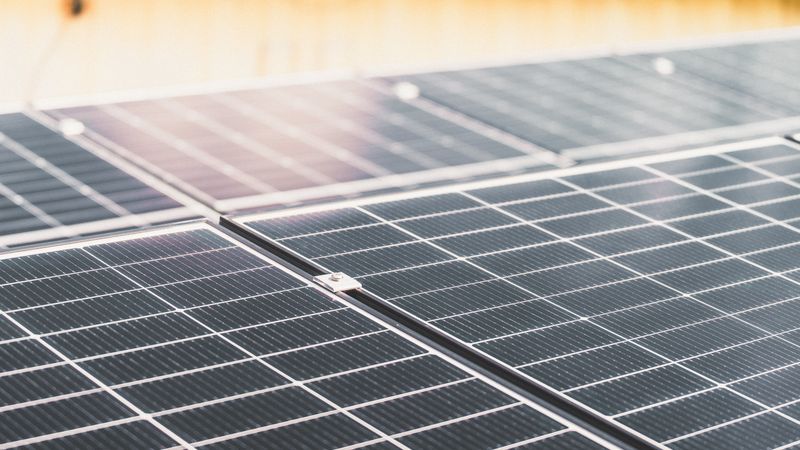
A microinverter mounts under each panel, or sometimes under each pair. It converts that panel’s DC to AC on the spot. The AC from many units joins in parallel on a branch circuit, which runs to your breaker panel.
There is no high-voltage DC string. Each panel works independently, so panel mismatch cannot drag down its neighbors. The trade-off is that every unit is a full inverter sitting under a hot roof panel, and there are many more of them.
Compatibility matters here. Check the microinverter’s maximum DC input power and voltage against your panel’s rating. A big panel on a small microinverter can clip, meaning some output is cut off at peak. Branch circuits also have a limit on how many units each breaker can carry. Your installer should size this from the manufacturer’s datasheet.
Side-by-side comparison
| Feature | Power optimizer + string inverter | Microinverter |
|---|---|---|
| Where DC becomes AC | Central inverter | At each panel |
| Central inverter needed | Yes | No |
| Electronics on the roof | One optimizer per panel | One microinverter per panel (or pair) |
| Roof wiring | DC at regulated fixed voltage | AC |
| Shading response | Per-panel MPPT | Per-panel MPPT |
| Rapid shutdown | Commonly designed to meet NEC 690.12 | Commonly designed to meet NEC 690.12 |
| Typical warranty | 25 years on optimizers; inverter often shorter | 25 years typical |
| Failure impact | Optimizer: one panel. Inverter: whole system | One panel |
| Battery fit | Depends on inverter model; some support DC coupling | Usually AC-coupled batteries |
| Typical cost | Above a plain string inverter, usually below microinverters | Usually the highest cost per watt |
Pricing varies by market and installer, so use the cost row as a ranking, not a quote.
Which performs better with shading, soiling or mixed roof orientations?
For this question, they perform about the same. Both track the maximum power point panel by panel, so a shaded, dirty or oddly angled panel only limits itself. A basic string inverter has the mismatch problem: shade on one panel can pull down the output of the whole series string.
Mixed roof faces also work well with MLPE. East and west panels can sit on the same system without forcing one compromise voltage. Optimizer systems can handle this too, within the inverter’s string rules.
Worked example: one shaded panel
Here are the assumptions, so you can redo the math with your own numbers:
- 20 panels at 400 W each, which is an 8 kW system
- 4.5 peak sun hours per day, all year
- 14% system losses, which gives 8 kW x 4.5 x 365 x 0.86 = about 11,300 kWh per year
- Each panel makes about 565 kWh per year (11,300 divided by 20)
- One panel is shaded during hours that make 25% of its yearly energy, and it loses 60% of its output in those hours
- Two strings of 10 panels each for the string inverter case
- Worst case for the string inverter: the whole shaded string drops by 60% in those hours (bypass diodes in real panels soften this)
- Small conversion differences between devices are ignored
| System | Annual loss | Value at 17 cents/kWh |
|---|---|---|
| String inverter only | About 850 kWh (5,650 x 0.25 x 0.6) | About $144 |
| Power optimizers | About 85 kWh (565 x 0.25 x 0.6) | About $14 |
| Microinverters | About 85 kWh | About $14 |
MLPE saves roughly 765 kWh a year here, or about $130 at the national average near 17 cents per kWh (U.S. Energy Information Administration). At 12 cents it is about $92. At 40 cents it is about $306. Compare that yearly figure to the extra price on your quote. Without shade, the savings drop close to zero.

Which costs more upfront, and how does cost compare per panel?
Microinverters usually cost the most per watt. Optimizers sit between a plain string inverter and microinverters. The exact gap depends on your installer, region and equipment, so ask for quotes on both with the cost per watt listed.
Remember the optimizer system still includes a central inverter. Compare the full installed price, not just the cost per panel device. Also ask what happens to labor cost if a device must be replaced after the warranty period.
Which is more reliable, and what happens when a unit fails?
Typical manufacturer warranties for both SolarEdge optimizers and Enphase microinverters are 25 years. String inverters often carry 10-12 years, though extensions exist. Warranty terms differ on labor, so read what is covered, not just the number of years.
The bigger difference is failure impact.
| What fails | What stops | What a repair involves |
|---|---|---|
| Microinverter | That one panel | Roof access, lift the panel, swap the unit |
| Optimizer | That panel (or its output) | Roof access, lift the panel, swap the unit |
| Central inverter (optimizer system) | The whole system | Wall-level swap, no roof work |
| String inverter, no MLPE | The whole system | Wall-level swap |
So a central inverter is a single point of failure. It is easier to fix because it sits on a wall. A roof device is harder to fix, but a failure costs you one panel’s output. If you ever replace the roof, panels must come off either way, and more roof devices mean more parts to handle and reconnect.
How does each handle rapid shutdown and safety requirements (NEC 690.12)?
Both can meet it. Under NEC 690.12, conductors inside the array boundary must drop to 80 V or less within 30 seconds of initiating shutdown. Microinverter and optimizer systems are both commonly designed to meet this, while a plain string inverter needs add-on devices.
Microinverters have no high-voltage DC string on the roof, which many owners see as a safety plus. Optimizers hold the string at a regulated voltage and drop it on shutdown. Neither design lets you skip the grid shut-off. In an outage, standard grid-tied systems shut off on purpose to protect line workers. Never bypass that function. Have a licensed electrician handle all connections to your breaker panel.
How does monitoring differ between the two?
Both Enphase and SolarEdge provide panel-level monitoring through their apps and portals. You can see which panel is underperforming and when. That makes shade, dirt and dead units easy to spot.
The weak spot is connectivity. Microinverter systems report through a gateway, and owners mention gateway or Wi-Fi issues that need resets. Ask your installer how data reaches the cloud and who handles troubleshooting.
Which is better for adding batteries or expanding the system later?
Microinverters make expansion easy. Add a panel and a microinverter, within the branch circuit limit, and the rest stays as is. Optimizer systems can grow too, but the central inverter has a size cap and string rules, so a big expansion may mean a new inverter.
For batteries, it depends on the model. Some optimizer-compatible inverters support DC-coupled batteries. Microinverter systems usually use AC-coupled batteries. Either way, a battery with proper backup gear is what keeps power on in an outage, not the panel electronics alone. Ask for the specific battery and inverter pairing in writing.
How to choose
- Heavy shade or several roof faces? Choose either MLPE type. Microinverters if budget allows.
- Planning to add panels later? Lean toward microinverters.
- Complex roof with many small sections? Microinverters are simpler to lay out.
- Tight budget, one clean roof plane, no shade? A string inverter, or optimizers if you want panel monitoring.
- Battery plans? Compare the battery pairing first, then pick the panel electronics to match.
- Dislike one point of failure? Choose microinverters.
What do owners say?
Owners like
- Panel-level monitoring that quickly shows which panel is underperforming
- Good production on partially shaded or multi-orientation roofs
- Long 25-year warranties give peace of mind
- Microinverter systems feel safer with no high-voltage DC on the roof
- Easy to add more panels later, especially with microinverters
Common complaints
- Higher upfront cost than a basic string inverter
- Replacing a failed unit on the roof can require labor and access costs after warranty labor coverage ends
- Optimizer systems depend on one central inverter, so an inverter fault stops all production
- Monitoring gateway or connectivity issues requiring resets or troubleshooting
- Some owners report early failures of individual units and slow replacement turnaround
Summarised from owner reviews and long-term user reports; individual experiences vary.
Frequently Asked Questions
What is the difference between optimizer and microinverter?
An optimizer conditions each panel’s DC power and sends it to one central inverter. A microinverter converts each panel’s power to AC on the roof. The first design keeps a central inverter, and the second removes it.
What is the difference between power optimizer and micro inverter in cost?
Microinverters usually cost more per watt. Optimizers typically sit between a plain string inverter and microinverters, but local pricing varies. Compare full installed quotes, including the central inverter.
Do I still need a central inverter with optimizers, and is it a single point of failure?
Yes, you still need one. If it fails, the whole system stops producing until it is replaced. It is wall-mounted, so replacing it is usually simpler than roof work.
What happens when one panel or one unit fails in each system?
With microinverters, only that panel stops. With optimizers, a failed optimizer affects its panel, but a failed central inverter stops everything. Both roof repairs need access to the panel.
Which is better for shading?
Both handle shade well because each panel is tracked on its own. The gain over a string inverter is large on shaded roofs and small on clean, single-plane roofs.